


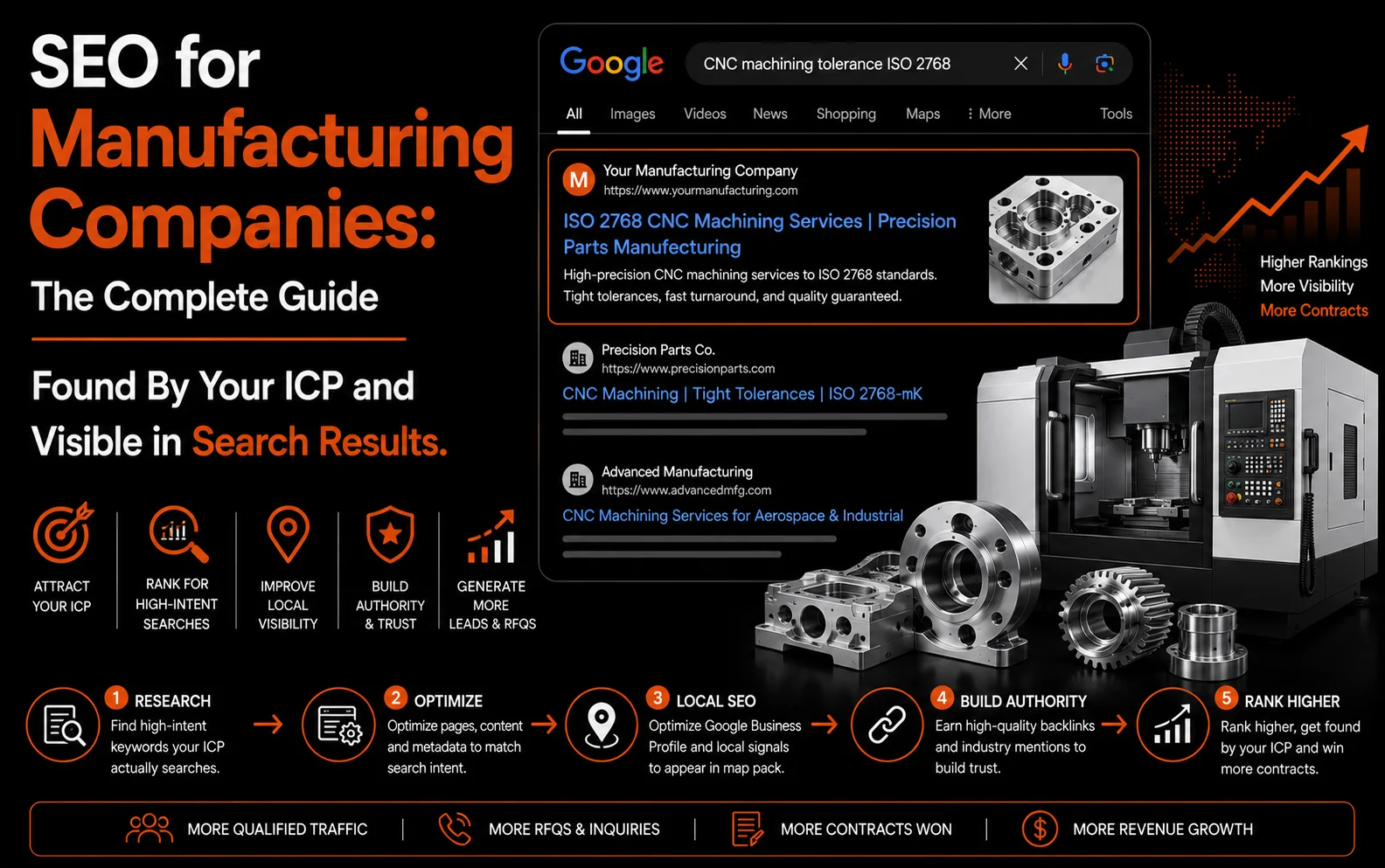
SEO For Manufacturing Companies: The Complete Guide To Ranking And Winning RFQs
Manufacturing search engine optimization is the process of making your business visible to the procurement engineers, supply chain managers, and OEM buyers who are already searching on Google and even now getting recommendations from AI modules (ChatGPT, Gemini, Claude) for exactly what you make. This guide covers everything from the keywords that drive inbound RFQs to technical SEO, local SEO, AI search visibility, schema markup, content strategy, and how to measure real ROI. Written by a manufacturing SEO specialist with 5 years of exclusive focus on industrial companies — not a generic content agency guessing what works for your industry.
- →Why most manufacturing websites get some traffic but zero RFQs — and the structural mistake that causes it
- →The exact keyword formula procurement engineers use when they are ready to place a contract — not when they are browsing
- →How to build service pages that rank for buyer-intent searches and convert visitors into quote submissions
- →Why local SEO works better for B2B manufacturing than most companies expect — and how to dominate it fast
- →How manufacturing companies get recommended by ChatGPT, Perplexity, and Google AI Overviews in 2026
- →The image optimization formula that helps manufacturing pages rank faster and load cleaner on mobile
- →Real case study: how one manufacturer turned a $45k SEO investment into $2.5M in inbound contracts in 9 months
Quick answer: SEO for manufacturing works when it targets how buyers actually search — by capability, certification, material, and location. Generic traffic does not generate RFQs. Specific, buyer-intent visibility does.
Why Does Manufacturers SEO Matter More Than You Think?
The way industrial buyers find new suppliers has changed from the past. A procurement manager with an open contract and a two-week deadline does not wait for a trade show or manufacturing directories like (MFG, Thomasnet). They open Google. They search "AS9100 certified CNC machining service in Ohio" or "ISO certified metal fabrication shop in Texas" and they build their shortlist from the first page of results.
If your company is not in those first positions, you are not on the shortlist. Not because you are less qualified — because you were never found in Google's top 3 positions and Google AI Overviews. The contract goes to a competitor who may have inferior capabilities but a website that Google understands and ranks.
Manufacturing companies that rely entirely on trade shows, referrals, and distributor networks are operating on a buyer model that no longer dominates. The modern procurement professional completes more than half their research online before making a single phone call. By the time they contact a supplier, they have already visited the website, checked certifications, read reviews, and decided whether to shortlist or skip.
The manufacturing companies growing fastest in 2026 are not necessarily those with only the best equipment. They are the ones that understood this shift early and built a digital presence that matches how industrial buyers actually search. Organic search has no ceiling — unlike referrals, which are permanently capped by the size of your existing network.
Who Is Searching For Your Manufacturing Company And What Are They Actually Searching?
Most manufacturing companies make one assumption that kills their entire SEO strategy: generalist agencies or owners believe their buyers search the way a general consumer does. They do not. Industrial buyers search with extreme specificity — and understanding this changes everything about how you build your website and content.
Three distinct buyer profiles search for manufacturing suppliers online. Each searches differently, reads differently, and converts differently:
Procurement Engineers — the highest-value searcher
They have a blueprint, a deadline, and an approved budget. Their searches are hyper-specific: "AS9100 certified CNC turning service in Texas," "ITAR registered precision machining in Houston," "Inconel machining for aerospace California." They are not researching — they are shortlisting. Get in front of them at this stage and you get the RFQ.
Supply Chain Managers — the compliance-focused searcher
They search by certification compliance and industry application: "ISO 9001 certified manufacturer in Ohio," "FDA compliant plastic injection molding in Michigan," "precision machining for medical devices in Michigan." They need documentation, supplier qualification records, and audit access. Your website must confirm all of these without them needing to ask.
OEM Buyers — the volume and capability searcher
They search for long-term manufacturing partners: "contract manufacturer aluminum parts," "high volume CNC production parts manufacturer in Ohio," "custom machining manufacturer energy sector." They care about capacity, consistency, and scalability over years — not just one job. Your content needs to address ongoing partnership, not just one-time capability.
A single generic "Services" page addresses none of these three buyers specifically. That is why most manufacturing websites get visitors but generate almost no inbound RFQs — the content is built for no one in particular. Understand the complete user search behaviour in detail.
Your website does not just need to be found. It needs to be found by the right buyer, with the right content waiting for them when they arrive. A procurement engineer who lands on a page called "What Is Injection Molding" leaves immediately. The same engineer who lands on "ISO 9001 Custom Injection Molding Automotive, Michigan" stays, reads, and submits an RFQ.
Which Keywords Actually Drive RFQs For Manufacturing Companies And Which Just Drive Traffic?
This is the most important question in manufacturing SEO — and the one most companies never ask their digital marketer. Traffic and RFQs are not the same thing. A manufacturer can rank for hundreds of keywords, receive thousands of monthly visitors, and generate zero inbound enquiries if they are targeting the wrong intent.
The keywords that generate actual contracts follow four predictable formulas. They combine specificity about what you make, the certification that qualifies you, and the location the buyer needs:
| What Buyers Type | Who Searches This | RFQ Likely? | Intent |
|---|---|---|---|
| AS9100 CNC machining Texas | Procurement engineer, active aerospace contract | Yes — within the session | RFQ Ready |
| ISO certified metal fabrication Ohio | Supply chain manager, compliance requirement | Yes — high confidence | RFQ Ready |
| precision machining aerospace Michigan | Engineer, active program, needs local shop | High — if experience shown | RFQ Ready |
| CNC manufacturing company near me | Local buyer, wants proximity and fast turnaround | Medium — evaluating options | Evaluating |
| seo for manufacturing | Manufacturing owner researching marketing | Not a parts RFQ | Research |
| manufacturing services | Mixed — students, researchers, competitors | Rarely | Low Intent |
| what is injection molding | Student or curious reader | Never | Not a Buyer |
The rule is consistent: the more specific the keyword, the higher the buyer intent. Someone searching "ITAR registered CNC machining shop in Texas or city Dallas" has already narrowed their requirement to a specific compliance standard, a specific process, and a specific location. They are not browsing — they are shortlisting. For the full breakdown of how buyers search at each stage, read our guide on why engineers search Google for CNC companies and what they actually type.
How Do You Build Manufacturing Service Pages That Rank and Convert Buyers?
On-page SEO for manufacturers is not about stuffing keywords into existing pages. It is about building the right pages in the first place — pages that match exactly how buyers search, and that answer every question they have before they need to ask it.
The structure that works: one dedicated page per process, per certification, per material, and per location. Not one "Services" page covering everything. Specific pages that each rank for one specific search pattern.
What must every manufacturing service page include to convert a procurement engineer?
- Exact tolerance range — "±0.001 inch" not "high precision." Engineers need numbers, not adjectives.
- Materials list — name every material you work with: Inconel 718, titanium 6Al-4V, 17-4 PH, 4140, 6061-T6. Generic "all metals" tells a buyer nothing.
- Certifications with revision numbers — AS9100 Rev D, ISO 9001:2015, ITAR registration. Not just logos — specific revision numbers and what they mean for the buyer's contract requirements.
- Equipment specifications — brand, model, axis count, table size, spindle speed. An engineer needs to know if your equipment can physically produce their part before investing time in an RFQ.
- Industries served with specifics — aerospace, defense, medical, energy, automotive. Named industries build confidence that generic claims never can.
- Real facility and part photos — your actual machines, CMM equipment, completed parts, inspection reports. Not stock photography.
- A specific documented result — "38% RFQ growth in 90 days" is more persuasive than "we deliver quality."
Our complete guide on CNC company SEO services covers how Rankvi structures every one of these pages for maximum ranking and conversion performance.
What Off-Page SEO Actually Moves Rankings for Manufacturing Companies?
Off-page SEO is everything that happens outside your website that signals to Google you are a trusted, authoritative source for manufacturing buyers. In industrial SEO, relevance matters far more than volume — one link from a recognized manufacturing trade publication is worth more than 200 links from generic directories.
| Backlink Source | Ranking Impact | Why It Works |
|---|---|---|
| Manufacturing trade publications | Very High | Industry-relevant authority Google recognizes as credible for manufacturing topics |
| Industry associations (NTMA, AMT, PMPA) | High | Signals genuine membership in the manufacturing community |
| Customer preferred supplier pages | High | A link from an aerospace prime or OEM is among the most credible possible in this industry |
| Local suppliers and distributors | Medium-High | Locally relevant, commercially related — strong signal for local and regional SEO |
| Earned content links (guides, tools) | Medium | Engineers link to useful resources — genuine editorial signals Google values highly |
| Generic business directories | Very Low | No industry relevance, dilutes your link profile without contributing ranking signals |
| Paid link packages | Harmful | Risk of Google penalty, zero editorial value — actively damages long-term rankings |
How Do Manufacturing Companies Dominate Local Search and Win the Google 3-Pack?
Local SEO is underused in manufacturing — and that makes it a significant competitive advantage for companies that implement it correctly. Procurement managers prefer local suppliers for on-site audits, fast turnaround, and heavy components that are expensive to ship cross-country.
Complete your Google Business Profile with zero gaps
Business category, complete service list, description with your city and primary certification, hours, phone, address — all accurate and complete. An incomplete GBP is invisible in Maps results regardless of how strong your website is.
Upload real facility and product photos — never stock images
Real photos of your production floor, machinery, completed products, and inspection equipment. Procurement managers judge credibility instantly from photos — stock imagery signals a company hiding its actual facility.
Build a systematic Google review strategy
10+ verified reviews is the entry threshold for competitive 3-pack visibility. The highest-performing method: a direct, personal request from the account manager after every successful delivery. Response rates are 3–5x higher than mass email requests.
Create geo-targeted service pages for every region you serve
A manufacturer in Cleveland that also serves Pittsburgh and Columbus needs dedicated pages for each city — not one state-wide page with all cities mentioned. Each page targets the specific search patterns buyers in that metro use.
Audit and fix NAP consistency across all directories
Name, address, and phone must be identical across Google, Bing Maps, ThomasNet, MFG.com, and your website. A single inconsistency creates a citation conflict that suppresses local rankings. This is a 30-minute task most manufacturers have never completed.
Our step-by-step guides on local SEO for CNC companies cover the full implementation in detail.
Shamrock Precision was an AS9100-certified, ITAR-registered CNC manufacturing company in Texas. Every lead came from referrals. Zero inbound from Google. Their website had one generic "Machining Services" page and content written for students rather than procurement engineers.
Rankvi rebuilt their digital presence: targeted service pages per process and certification, GBP fully optimized with real shop photos and genuine reviews, complete internal linking silo, technical content that engineers actually search for, and real backlinks from manufacturing industry sources. By month 3, RFQ contact page submissions were up 38%. By month 9, $2.5M in inbound contracts had been generated from organic search alone — zero paid advertising.
100% organic SEO. No paid ads.
What Content Strategy Builds Genuine Authority for Manufacturing Companies?
Content authority separates a manufacturing website that ranks for 5 searches from one that ranks for 75+. Google rewards websites that demonstrate genuine depth of expertise across a specific industrial topic. AI tools like ChatGPT and Perplexity also cite websites with this depth when answering procurement sourcing questions.
The mistake most manufacturers make: writing for the wrong reader. "What is injection molding?" attracts students. "How Wall Thickness Affects Cycle Time in Injection Molded Nylon 66 Components" attracts engineers who bookmark it, share it internally, and link to it. The second article compounds in value for years. The first does nothing measurable.
What content should manufacturing companies publish?
- Process-deep technical articles — specific to your processes, materials, and industries. Content that only someone with real floor experience could write.
- Material-specific capability articles — "Machining Inconel 718: Tooling, Feed Rates, and Tolerance Considerations." These rank for long-tail searches and demonstrate expertise no generalist can fake.
- Buyer-facing qualification guides — "What Aerospace Primes Look for When Qualifying a New CNC Supplier." These attract buyers at the research stage and build trust before they ever contact you.
- Regional and industry combination articles — "CNC Machining for Aerospace Companies in Texas." These capture geo-specific searches with strong buyer intent.
- Documented case studies with real numbers — specific outcomes: industries, challenges, materials, tolerances, lead times, measurable results. Case studies are the highest-converting content type for industrial B2B buyers.
For the full content pipeline strategy Rankvi uses for manufacturing companies, read how we grow the inbound RFQ pipeline for a manufacturing business.
What Technical SEO Does A Manufacturing Company Website Actually Need?
Technical SEO is the foundation everything builds on. Strong content and good local signals are suppressed if Google cannot access your pages efficiently — or if your site loads slowly on mobile, where many procurement engineers actually browse.
- Page load speed under 2.5 seconds on mobileProcurement engineers access supplier websites from phones on factory floors and at airports. The biggest speed culprits on manufacturing sites: uncompressed product photos, Calendly widgets loading globally, unused third-party scripts. Load only what the page needs.
- Complete internal linking — no orphaned pagesEvery service page, location page, and technical article must be reachable through internal links. Google only ranks pages it can crawl. A precision machining page with no links pointing to it is invisible regardless of how strong its content is. Connect everything: service to blog to RFQ form.
- Correct H1-H2-H3 heading hierarchy on every pageOne H1 per page containing the primary target keyword. H2s for major content sections. H3s for subsections. Google uses heading structure to understand page content — wrong hierarchy suppresses ranking potential of otherwise strong pages.
- HTTPS on every page — no mixed content errorsInsecure pages trigger browser warnings that cause buyers to leave before reading a word. Google also uses HTTPS as a ranking signal. Every manufacturing website must run fully on SSL in 2026 — this is non-negotiable.
- Zero duplicate content across service pagesIf your CNC turning page and CNC milling page share the same boilerplate paragraph, Google treats both as lower quality. Every page needs unique content specific to that service, certification, or location.
- Updated XML sitemap and clean crawl errorsYour sitemap tells Google which pages to crawl and index. Outdated sitemaps with removed pages create crawl errors that waste crawl budget. Check Google Search Console monthly for 404 errors and fix them promptly.
Our technical SEO audit and implementation service covers a full audit and fixes for manufacturing websites.
How Should Manufacturing Companies Optimize Images for SEO and Page Speed?
Manufacturing websites have a natural advantage: real product photos, real equipment, real parts, real CMM reports. This is gold for both SEO and buyer trust — but only if the images are optimized correctly. Unoptimized images are the single biggest PageSpeed killer on most manufacturing websites.
File name: [product]-[spec]-[process].webp — e.g., inconel-718-5axis-milling.webp
Alt text: [Descriptive action] + [Key spec] + [Application] — e.g., "5-axis CNC milling Inconel 718 turbine bracket ±0.0005 inch tolerance aerospace"
Never use: IMG_4521.jpg, photo1.png, product-image.jpg
Three image rules that directly impact manufacturing SEO rankings
- Convert all images to WebP format — WebP files are 25–35% smaller than JPG at the same visual quality. For manufacturing sites with dozens of product and equipment photos, this alone can cut page load time by 1–2 seconds.
- Add
loading="lazy"to all images below the fold — this delays loading of images not immediately visible, significantly reducing initial page load. Critical for mobile PageSpeed scores above 90. - Set explicit width and height on every image — this prevents Cumulative Layout Shift (CLS), which Google measures as a Core Web Vital. Images loading without set dimensions cause visible page jumps that Google penalizes in mobile rankings.
How Do Manufacturing Companies Get Recommended by ChatGPT, Perplexity, and Google AI in 2026?
AI search is not a future consideration for manufacturers — it is an active sourcing channel right now. Procurement managers are asking ChatGPT and Perplexity to recommend certified manufacturers before they open Google to verify each one individually.
Getting cited in AI responses requires three things working together: topical authority (multiple well-structured pages covering your specific processes, certifications, materials, and industries), consistent entity information (your company name, location, certifications stated consistently everywhere), and schema markup (making your capabilities machine-readable for AI extraction).
Our complete guide on how to rank a manufacturing company in AI search results covers the full GEO and AEO strategy for industrial B2B companies.
How Do You Know If Your Manufacturing Company SEO Is Actually Working?
Traffic is a vanity metric. The only numbers that matter are RFQ submissions from organic search — and the contract value those submissions generate. Set up conversion tracking in GA4 specifically for RFQ form submissions segmented by organic search traffic before you invest a single dollar in SEO.
Review your target keyword rankings monthly — specifically the 10 to 20 buyer-intent searches that matter most for your processes, certifications, and locations. Movement from position 12 to position 4 over 6 months tells you the strategy is working long before revenue visibly changes. Rankings move before revenue moves. Track both separately from vanity traffic metrics.
For a complete look at how Rankvi builds and measures inbound pipelines for manufacturers, read our breakdown at the B2B manufacturing sales funnel.
Frequently Asked Questions
Manufacturing SEO is the process of optimizing a manufacturer's website so it appears in Google search results in top 3 positions when procurement engineers, supply chain managers, and OEM buyers search for specific manufacturing capabilities. It includes keyword targeting, service page optimization, local SEO, technical SEO, schema markup, content strategy, and link building — all focused on generating inbound RFQs rather than general traffic.
Most manufacturing companies see measurable results within 60 to 90 days when on-page SEO and Google Business Profile optimization are correctly implemented. Full ranking authority and a compounding inbound pipeline develop over 6 to 12 months. Shamrock Precision saw 38% RFQ growth in 90 days and $2.5M in inbound contracts within 9 months of starting with Rankvi.
Target high-intent keyword combinations: capability plus certification plus location (e.g. "AS9100 CNC machining Texas"), material plus process plus location (e.g. "Inconel machining Houston"), and industry plus specification (e.g. "aerospace precision machining California"). Generic terms like "manufacturing company" bring traffic but rarely convert to RFQs.
Yes. Even manufacturers with national clients benefit from strong local SEO because procurement managers frequently prefer local suppliers for audit access, faster turnaround, and reduced logistics cost on heavy components. Local dominance builds domain authority and review signals that improve national rankings. Rankvi's approach: dominate locally first, then expand nationally as authority compounds.
SEO compounds over time — the content and authority built today continues generating leads in year two and three without additional spend. For Shamrock Precision, a $45,000 SEO investment generated $2.5M in inbound contracts within 9 months — a 55x return. Paid ads would require ongoing spend to maintain those results and stop completely when budget runs out.
Manufacturing companies appear in AI-generated vendor recommendations by building topical authority through multiple well-structured pages covering specific processes, certifications, materials, and industries. Proper schema markup makes capabilities machine-readable for AI extraction. Consistent business information across the website, Google Business Profile, and industry directories all contribute to being cited in AI responses.
The single highest-impact fix is rebuilding service pages with buyer-intent content. Replacing a generic "Services" page with specific pages targeting individual processes, certifications, materials, and locations — such as "ISO Certified CNC Machining Ohio" — typically produces the fastest measurable RFQ growth because it matches exactly how procurement engineers search.
Ready To Turn Your Manufacturing Website Into An Inbound Lead Pipeline?
Rankvi specializes exclusively in SEO for manufacturing companies and industrial suppliers. We speak the language of the production floor from material specifications to compliance documentation. Book a free strategy call and we will show you exactly what is holding your company back from inbound RFQs.
