


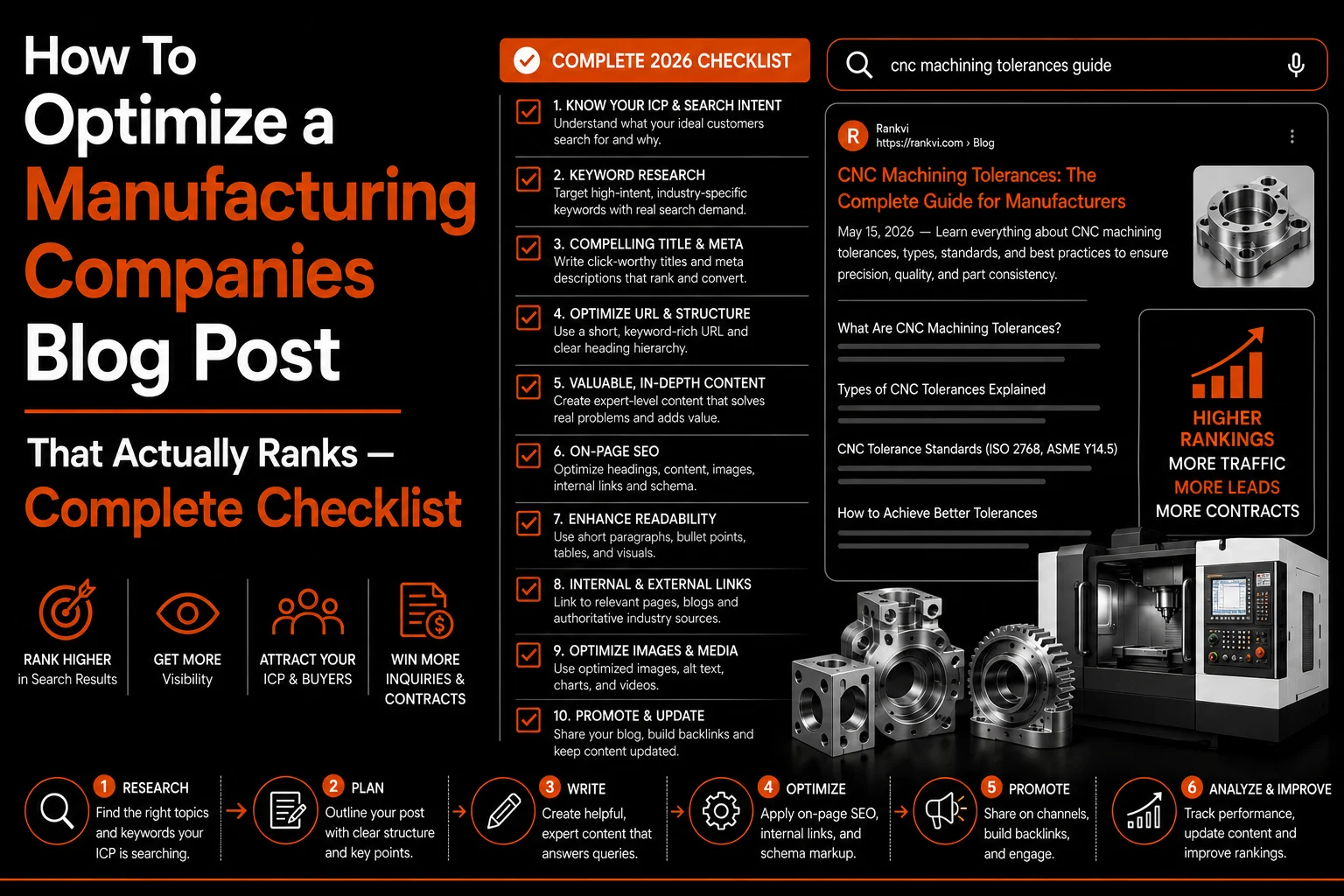
How To Optimize A Manufacturing Comppanies Blog Post That Actually Ranks — Complete 2026 Checklist
What You'll Learn in This Guide
- Why most manufacturing blog posts fail to rank and the one structural mistake that kills 80% of industrial content before it even gets crawled
- The 10-section blog optimization checklist built specifically for machine shops, fabricators, and industrial B2B companies in 2026
- How to write for NLP, semantic search, and AI answer engines simultaneously without sacrificing the technical depth your buyers demand
- Which schema markup types earn featured snippets and AI Overview citations for manufacturing and engineering content
- The exact on-page, technical, and E-E-A-T signals Google's quality raters check for when evaluating industrial B2B content
- A complete workflow checklist from writing to publishing to promotion — you can hand off to your team today
You wrote the article. Your engineer reviewed it. You published it. Six months later it sits on page four of Google, getting eleven organic visits a month, generating zero RFQs.
This is the most common content problem Rankvi sees when auditing manufacturing websites. The content itself is often genuinely good technically accurate, detailed, even helpful. But it's invisible, because the optimization layer was either skipped entirely or done wrong.
In 2026, ranking a manufacturing blog post requires three things working simultaneously: content that answers real buyer questions with genuine expertise, a technical on-page structure that Google can parse, and signals that tell AI answer engines ChatGPT, Perplexity, Google's AI Overviews that your content is authoritative enough to cite. Miss any one of these, and you're competing with one arm tied behind your back.
This guide gives you the complete, step-by-step optimization framework Rankvi uses for machine shop, fabricator, and industrial B2B content. Every element is explained, with manufacturing-specific examples throughout.
Why Do Most Manufacturing Blog Posts Fail To Rank?
The single most common reason a manufacturing blog post fails to rank isn't poor writing, thin content, or even bad keyword targeting though all of those matter. The most common reason is that the post was optimized for no one in particular.
Generic industrial content "What is CNC milling?" "The benefits of precision machining" exists in infinite supply. Google's language model has read millions of pages on these topics. Publishing another shallow take doesn't give Google a reason to rank your version over a competitor with ten years of domain authority.
What does rank in 2026 is content with a clearly identifiable author with verifiable expertise, that answers a specific question a specific buyer is asking, structured in a way Google's systems can parse and AI engines can cite.
- Generic "what is" content written for no specific buyer
- No author credentials or E-E-A-T signals
- One massive wall of text with no heading structure
- Published and forgotten — zero promotion
- No schema markup for rich results or AI citations
- Internal links only to the homepage
- Images with "IMG_1234.jpg" filenames
- Answers a specific question a procurement engineer actually types
- Author box with engineer credentials and role
- Question-based H2/H3 headings that match search queries
- Shared on LinkedIn, sent to email list, submitted to GSC
- Article + FAQ + HowTo schema markup implemented
- Links to 3–5 relevant service pages and related articles
- Descriptive image filenames and spec-rich alt text
After auditing 40+ manufacturing websites, the most common on-page issue isn't missing keywords — it's missing internal links. Articles that don't link to relevant service pages leave conversion potential sitting on the table every day. If you're writing about "CNC machining tolerances," that article should link to your machining services page and your RFQ page naturally within the body.
How Do You Write Blog Content That Satisfies Both Buyers And Google?
Great manufacturing content starts before you open a document. It starts with understanding what the buyer actually needs to know not what's easy to write about.
A procurement engineer shortlisting CNC vendors for a $300k aerospace contract doesn't need a definition of turning, & milling. They needs to know your achievable tolerances, what materials you've held them in, what certifications back up your capability claims, and what your lead time looks like. That specificity is what separates content that earns RFQs from content that earns nothing.
Write for your buyer, hoow you solve their problems not for a keyword count. Cover the topic completely: what it is, why it matters, how to evaluate it, what the trade-offs are, and what the right choice looks like in a real manufacturing context. Optimization comes after. Thin content with perfect metadata still fails.
Identify whether the searcher wants information (how does X work), comparison (X vs Y), process (how to do X), or product (where to buy X). Your article should fully satisfy that intent. If someone searches "how to select CNC tolerances," they want a buying decision framework — not a definition of what tolerances are.
Have your application engineer weigh in on a real trade-off. Include a tolerance spec from a job your shop actually ran. Reference an industry standard (ISO, ASME, ANSI, AS9100) with specific clause context. This is the content that earns citations from AI answer engines in 2026.
Not because longer is better — but because a topic that genuinely deserves ranking usually requires enough depth to cover it well. A 300-word article on "5-axis milling tolerances in aerospace" can't compete with a 2,500-word definitive guide from a shop that has done it 200 times.
Google's AI Overviews, ChatGPT browsing, and Perplexity all select cited sources based on the same signals: entity clarity (who wrote this, what company are they from), factual specificity (real numbers, real standards), and structured answers (the content directly and concisely answers the question). Write with these three in mind from the first paragraph.
What On-Page SEO Elements Does Every Manufacturing Article Need?
On-page SEO is not about repeating a keyword eighteen times. It's about signal clarity giving every element of the page a job that communicates relevance, authority, and context to both search crawlers and human readers.
Title Tag: Your Most Valuable 60 Characters
The title tag is the single most important on-page SEO element. It's what appears in the SERP, what AI engines use to understand the article's topic, and what humans click (or don't). For manufacturing content, include your main keyword near the beginning and make it specific enough to be click-worthy for your actual buyer.
| Element | Rule | Manufacturing Example |
|---|---|---|
| Title Tag | Under 60 chars · Keyword near start · Click-worthy | "CNC Machining Tolerances: Complete Guide for Procurement Engineers" |
| URL Slug | Short · Hyphenated · Keyword included | rankvi.com/cnc-machining-tolerances |
| H1 Tag | One per page · Matches title intent · Main keyword present | "CNC Machining Tolerances: What Procurement Teams Need to Know" |
| First 100 Words | Main keyword appears naturally · Addresses buyer pain point | Mention tolerance requirements in context of procurement risk |
| H2/H3 Headings | Question-based · Include related keywords · Hierarchical | "What Tolerance Class Should You Specify for Aerospace Components?" |
| Image Alt Text | Descriptive · Spec-based · No keyword stuffing | "5-axis CNC machine holding ±0.001 inch tolerance on Inconel 718" |
| Internal Links | 3–5 links · Descriptive anchor text · Link to service pages | "Learn more about our machine shop SEO" |
| External Links | 2–3 authoritative sources · Industry standards · Opens in new tab | ISO 2768 standard, ASME Y14.5, industry publications |
How Should You Handle Keyword Optimization in 2026?
Keyword density as a metric is obsolete. Google's NLP systems understand semantic relationships, entity co-occurrence, and topical completeness not keyword frequency. What matters now is whether your content comprehensively covers the topic around a keyword, not whether you repeated the phrase three times per 500 words.
For a manufacturing article on "CNC machining tolerances," you should also naturally cover: tolerance grades (IT grades), GD&T, surface finish (Ra values), material-specific considerations (aluminum vs titanium vs Inconel), measurement methods (CMM, gauge blocks), and cost implications. This semantic completeness is what earns rankings not the main keyword count.
Is your machine shop's content ranking below competitors with worse equipment? We audit and fix it.
Get A Consultation →How Should You Structure A Manufacturing Blog Post For Maximum Readability?
A procurement engineer scanning your article on a Monday morning between meetings doesn't read every word. She scans. She jumps to the section that answers her specific question. If your structure doesn't make that possible in under 10 seconds, she's gone and Google noticed that bounce.
The Ideal Heading Hierarchy for Industrial Content
H2: What Are CNC Machining Tolerances and Why Do They Matter?
H3: Standard vs Precision vs Ultra-Precision Tolerance Classes
H3: How Are Tolerances Measured in a Production Environment?
H2: How Do Tight Tolerances Affect Machining Cost and Lead Time?
H3: Material-Specific Tolerance Considerations
H3: The Cost Curve: When Tighter Isn't Better
H2: How to Specify Tolerances Correctly in Your Engineering Drawings
H2: What Questions Should You Ask Your CNC Supplier About Tolerances?
Notice three things about this structure: every H2 is a question a real buyer would ask, the hierarchy is logical (definition → cost impact → specification → vendor evaluation), and each H3 is a subtopic that adds depth without fragmenting the main flow.
For articles over 1,500 words, always include a Table of Contents with anchor links. This creates jump links that Google sometimes surfaces as sitelinks in the SERP, dramatically improving CTR. It also signals content depth to crawlers.
Paragraph and Formatting Rules That Improve Rankings
White space is not wasted space — it's readability. Short paragraphs reduce cognitive load, encourage scrolling, and improve mobile experience. Google's quality raters evaluate readability explicitly.
Lists are featured-snippet bait. When you list the "5 questions to ask your CNC supplier," Google can pull that list directly into a featured snippet, giving you position zero without a ranking change. Every list you add to a manufacturing article is a potential snippet opportunity.
Bold text catches scanners' eyes and signals importance to NLP systems. Bold the single most important phrase in a paragraph — not every technical term. If everything is bold, nothing is.
Your introduction must hook the reader immediately (address their exact pain point), include your main keyword naturally, and tell them precisely what they'll learn. Procurement engineers are busy. If paragraph one doesn't earn the next paragraph, you've lost them.
Which Schema Markup Types Should Manufacturers Use on Blog Posts?
Schema markup is structured data that tells Google and AI engines exactly what your content is, who wrote it, and what questions it answers. For manufacturing content in 2026, schema is not optional — it's what determines whether your article appears in featured snippets, AI Overviews, and knowledge panels, or stays invisible in standard blue links.
Article Schema — Every Manufacturing Blog Post
{
  "@context": "https://schema.org",
  "@type": "Article",
  "headline": "CNC Machining Tolerances: Guide for Procurement Engineers",
  "author": {
    "@type": "Person",
    "name": "Abdullah",
    "jobTitle": "Manufacturing SEO Strategist",
    "url": "https://rankvi.com/about-us/team/"
  },
  "publisher": {
    "@type": "Organization",
    "name": "Rankvi",
    "url": "https://rankvi.com"
  },
  "datePublished": "2026-04-29",
  "dateModified": "2026-04-29",
  "about": "Manufacturing SEO, blog optimization"
}
FAQPage Schema — Your Highest-Leverage Schema Type
FAQ schema on manufacturing articles is the single most powerful schema implementation for two reasons: it earns featured snippet real estate in standard Google results, and it's the primary format that AI engines like Perplexity and ChatGPT use when pulling cited answers. If you have a FAQ section in your article (you should), mark it up.
{
  "@context": "https://schema.org",
  "@type": "FAQPage",
  "mainEntity": [{
    "@type": "Question",
    "name": "What tolerance classes are achievable in CNC machining?",
    "acceptedAnswer": {
      "@type": "Answer",
      "text": "Standard CNC machining achieves ±0.005 inch (ISO IT10–IT12). Precision machining reaches ±0.001 inch (IT7–IT9). Ultra-precision processes achieve ±0.0001 inch or better (IT5–IT6), requiring specialized equipment and in-process measurement."
    }
  }]
}
HowTo Schema — Step-by-Step Manufacturing Guides
If your article walks through a process — how to evaluate a CNC supplier, how to specify tolerances correctly, how to read a material certification — use HowTo schema. Google surfaces these as rich results with numbered steps visible directly in the SERP, dramatically improving CTR over standard links.
| Schema Type | When to Use | SERP Benefit | AI Benefit |
|---|---|---|---|
| Article | Every blog post | Author display | Entity clarity for AI indexing |
| FAQPage | Any post with Q&A section | Featured snippet | Primary AI citation format |
| HowTo | Step-by-step process guides | Rich steps result | Procedural AI answers |
| BreadcrumbList | All pages with URL hierarchy | Breadcrumb in SERP | Site structure clarity |
| Organization | All pages (sitewide) | Knowledge panel | Brand entity recognition |
Not sure if your schema is implemented? We run a full technical audit and solve it.
Lets Rankvi Implement Technical SEO →How Do You Build E-E-A-T Signals Into an Industrial Blog Post?
E-E-A-T — Experience, Expertise, Authoritativeness, Trustworthiness is Google's quality framework for evaluating content. For manufacturing and industrial B2B content, it's particularly scrutinized because procurement decisions involve significant financial risk. Buyers and Google both want verifiable proof that you know what you're writing about.
Include real examples from your shop floor. Real job numbers. Real customer outcomes. "We ran a batch of 500 Inconel 718 turbine brackets to ±0.0005 inch for an aerospace OEM" carries more weight than "we specialize in tight tolerances." Photos from real projects, not stock images, are an explicit quality rater signal.
Add an author box to every article with the author's name, job title (Mechanical Engineer, Manufacturing SEO Specialist, Application Engineer), years of experience, and a link to their team profile page. "Written by James Chen, Application Engineer with 12 years in aerospace precision machining" is a concrete expertise signal. "Written by the Rankvi Team" is not.
Reference specific industry standards by name and clause. "Per ISO 2768-1, medium tolerance class applies to features not individually toleranced on the drawing." Link to ASME, ISO, trade publications, and government standards. This is what procurement engineers are trained to look for — and what Google's quality raters check for in technical content.
Display a visible "last updated" date on every article. Include a sources section at the bottom. Show your ISO, AS9100, or ITAR certification status in your author bio context. Trust for a manufacturing buyer is earned through transparency about your actual capabilities and credentials — not through marketing language.
A machine shop client added verified author bios with PE credentials and real job case studies to their top 10+ blog posts. Within 90 days, average time on-page increased by 42% and those articles started earning featured snippet appearances for spec-based queries. E-E-A-T isn't abstract — it produces measurable ranking outcomes. See our machine shop case study for full data.
What User Engagement Signals Matter Most For Manufacturing Content In 2026?
Google uses behavioral signals — how long people stay on your page, whether they click through to other pages, whether they return to the SERP immediately — as quality proxies. For manufacturing content, where buyers are highly sophisticated and know exactly what they want, engagement signals are especially meaningful.
Every manufacturing blog post should have a CTA that connects directly to the article's topic. An article on CNC tolerances should end with "Need tight tolerance machining for your next project? Request a quote." Not a generic "Learn more about our services." Specificity converts. Link to your services page or a dedicated RFQ form.
Add 2–3 genuinely related articles at the bottom of every post. "If you found this useful, you might also need: [How to Evaluate a CNC Supplier's Capability], [AS9100 vs ISO 9001: What's the Difference for Aerospace Procurement], [5-Axis vs 3-Axis Machining: A Cost-Benefit Guide]." Each click signals engagement quality to Google.
If your shop has a YouTube video — a machine running, a quality inspection, a process walkthrough — embed it in the relevant article. Video embeds increase average time-on-page significantly. They also earn a VideoObject schema opportunity and can rank independently in Google's video search results.
For articles over 2,000 words, add a mid-article CTA around the halfway point. Buyers who have read 1,000 words of your tolerance guide are highly engaged — that's the moment to offer "Download our tolerance specification template" or "Book a free capability consultation." Don't wait until the end to capture them.
What Technical SEO Checks Must You Run Before Publishing?
Technical SEO is the infrastructure layer that makes everything else work. Even the best-written, perfectly structured manufacturing article will underperform if it loads in 8 seconds on mobile, fails Core Web Vitals, or isn't properly crawlable.
| Technical Check | Target | Tool to Use |
|---|---|---|
| LCP (Largest Contentful Paint) | Under 2.5 seconds | PageSpeed Insights |
| CLS (Cumulative Layout Shift) | Under 0.1 | PageSpeed Insights |
| FID / INP (Input Delay) | Under 200ms | Chrome User Experience Report |
| Mobile Responsiveness | Pass — no viewport issues | Google Mobile-Friendly Test |
| Image Sizes | Under 150KB per image (WebP) | Squoosh, TinyPNG |
| Canonical Tag | Self-referencing canonical present | Screaming Frog |
| Internal Links | 3–5 contextual links to service/related pages | Manual review + Screaming Frog |
| Schema Validation | No errors in Rich Results Test | Google Rich Results Test |
File name: [product]-[spec]-[process].webp — e.g., inconel-718-5axis-milling.webp
Alt text: [Descriptive action] + [Key spec] + [Application] — e.g., "5-axis CNC milling Inconel 718 turbine bracket ±0.0005 inch tolerance aerospace"
Never: IMG_4521.jpg, photo1.png, product-image.jpg
Our technical SEo covers all of these checks as part of a full site audit. For manufacturing websites with large product catalogs, the crawl budget and faceted navigation issues are especially impactful fixing them often produces ranking improvements before a single piece of new content is written.
How Do You Promote A Manufacturing Blog Post After Publishing?
Publishing is not the finish line — it's the starting gun. A manufacturing article with no promotion strategy will sit unindexed or under-crawled for weeks. Active distribution is how you accelerate indexing, earn early engagement signals, and start building backlinks.
The moment you publish, paste the URL into the Google Search Console URL Inspection tool and request indexing. This can reduce indexing lag from weeks to days. It's free and takes 30 seconds.
Share the article on LinkedIn with a native post (don't just paste a link — write 150–200 words of context, add a question, and put the link in the first comment to maximize reach). Reshare it 3–4 times over 6 months with different angles. Tag any suppliers, customers, or industry figures you mentioned or linked to.
Send the article to your email list. Existing customers and warm prospects are your fastest source of engagement signals — they'll read it, share it, and sometimes link to it from their own websites. Consistent email promotion of manufacturing content compounds over time.
If this is pillar content (a comprehensive guide), add a link to it from your homepage, your services pages, and any relevant existing blog posts. Internal links from pages that Google already trusts pass authority to new content and accelerate its ranking trajectory.
Reach out to any industry publications, associations, or trade directories you linked to in the article. "We referenced your research in our guide thought you might want to see it." This is how earned backlinks start. Our off-page SEO service systematizes this process for manufacturing clients.
Is Your Machine Shop's Content Actually Bringing In RFQs?
Most manufacturing websites publish content that gets zero traction not because the company is bad, but because the optimization layer is missing. Rankvi specializes in manufacturing SEO. We audit your content, fix the gaps, and build a strategy that generates inbound leads from procurement engineers actively searching for what you make.
How Do You Measure and Improve Manufacturing Blog Performance?
Publishing without measurement is guessing. The metrics below tell you whether your content is performing, why it isn't, and what to do about it.
| Metric | Tool | What Good Looks Like | If It's Low — Check |
|---|---|---|---|
| Organic Traffic | Google Analytics 4 | Consistent monthly growth after 6 months | Keyword targeting, indexing status |
| Keyword Rankings | Google Search Console | Appearing in top 10 for target queries | On-page optimization, backlinks |
| Click-Through Rate (CTR) | Google Search Console | 3–8% for manufacturing content | Title tag and meta description |
| Average Engagement Time | Google Analytics 4 | 2–4 min for 1,500+ word articles | Content quality, structure, readability |
| Conversions (RFQs) | GA4 + CRM | 1–3% of engaged sessions → RFQ | CTA placement, CTA specificity |
| AI Overview Citations | Manual search + brand monitoring | Cited in at least 1 AI Overview | Schema markup, FAQ implementation |
When and How to Refresh Manufacturing Content
Manufacturing content has a shelf life. Industry standards get revised (ISO 2768 was last updated in 1989 — but ASME Y14.5 was revised in 2018 and again in 2023). Material grades change. Equipment capabilities evolve. Content that was accurate when published can become a trust liability when procurement engineers find outdated specs.
Review your top-performing articles every 6 months. Update statistics, add new sections that address questions you've seen in sales calls, improve internal links to newer related content, and refresh the "last updated" date. A refreshed article often recovers rankings faster than publishing a new one on the same topic.
Complete Manufacturing Blog Optimization Checklist
✅ Before You Write
- ✓ Identify the specific buyer persona and their exact search intent
- ✓ Confirm the target keyword is not already covered by an existing page (no cannibalization)
- ✓ Research semantic entities and related keywords to weave in naturally
- ✓ Plan the heading structure (H1 → H2 → H3) as questions buyers ask
- ✓ Identify 3–5 internal pages to link to (service pages, related articles, case studies)
✅ While Writing
- ✓ Main keyword in first 100 words — naturally, not forced
- ✓ 1,500–3,000 words for pillar content; shorter is fine for specific subtopic articles
- ✓ Max 3–4 sentences per paragraph
- ✓ One H1, hierarchical H2/H3 structure, question-based headings
- ✓ 3–5 internal links with descriptive anchor text
- ✓ 2–3 external links to authoritative industry sources (ISO, ASME, trade publications)
- ✓ Real examples, real numbers, real case study references
- ✓ FAQ section with 4–6 questions your buyers actually ask
- ✓ Contextual CTA(s) — mid-article and end-of-article
✅ Before Publishing
- ✓ Title tag under 60 characters with main keyword near start
- ✓ URL slug: short, hyphenated, keyword included
- ✓ All images: descriptive filename (WebP), compressed under 150KB, spec-rich alt text
- ✓ Table of Contents added (for articles over 1,500 words)
- ✓ Article + FAQPage + HowTo (if applicable) schema markup added
- ✓ Author box with credentials and team page link
- ✓ Mobile responsiveness confirmed
- ✓ PageSpeed: LCP under 2.5s
- ✓ Schema validated in Google Rich Results Test
✅ After Publishing
- ✓ URL submitted to Google Search Console for indexing
- ✓ Shared on LinkedIn (native post + link in first comment)
- ✓ Sent to email newsletter list
- ✓ Internal link added from relevant existing pages
- ✓ Added to content calendar for 6-month review
❌ Common Mistakes to Avoid
- ✕ Writing for Google instead of your actual procurement buyer
- ✕ Keyword stuffing — NLP understands context, not frequency
- ✕ No internal links to service pages or related articles
- ✕ Generic "written by admin" — no verifiable author credentials
- ✕ Publishing and forgetting — no submission, no promotion, no tracking
- ✕ Images as JPEGs at 2MB with "IMG_1234.jpg" filenames
- ✕ No schema markup — invisible to AI Overviews and rich results
- ✕ Never updating old content — outdated specs are a trust liability
