


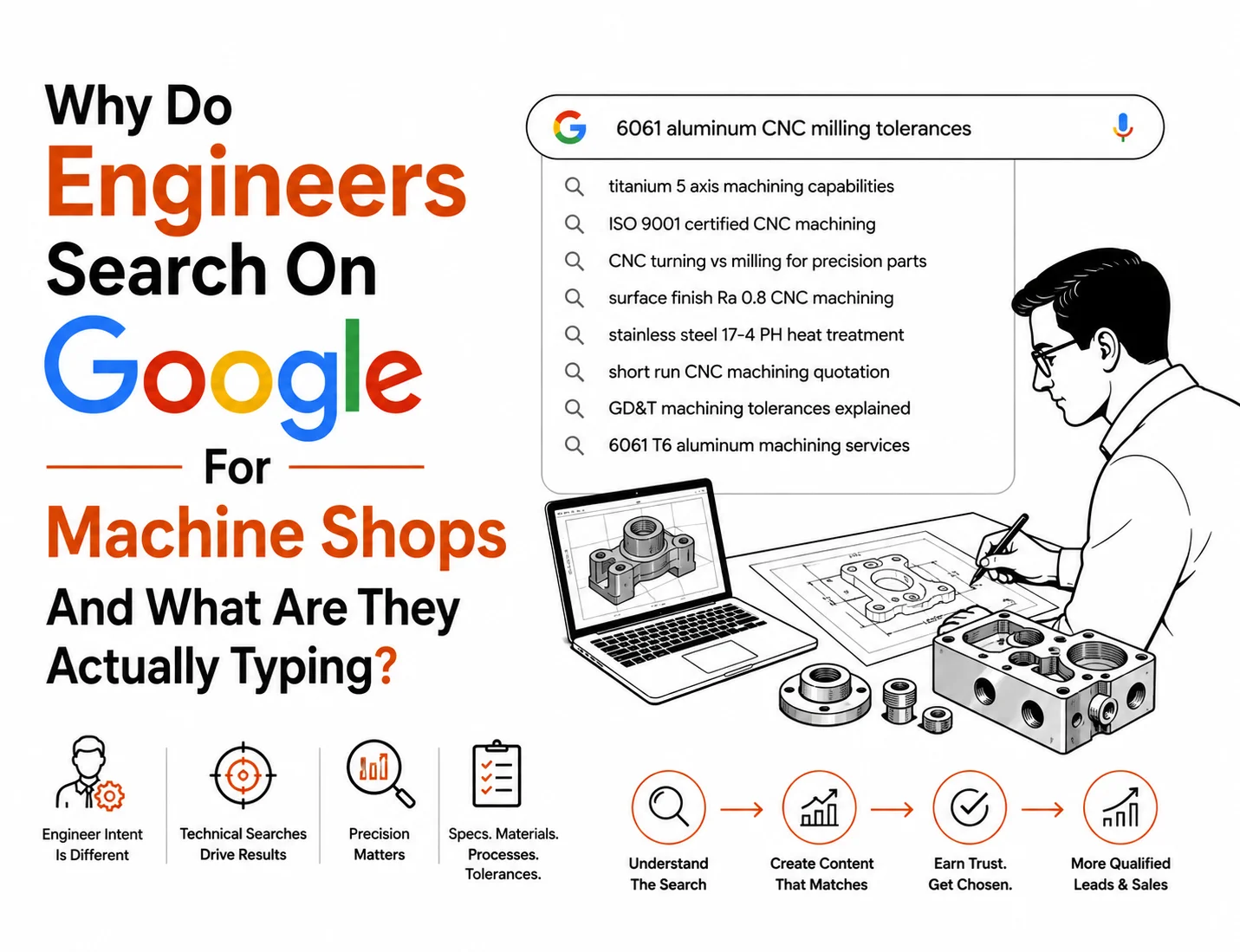
Why Do Engineers Search Google For CNC Machine Shops And What Are They Actually Typing?
Most CNC machine shops target the wrong intent and wrong keywords they think buyers use. They're wrong. Here's exactly how procurement engineers search — and why the gap between what shops target and what buyers type is costing shops contracts every day.
Why Do Engineers Use Google To Find CNC Machine Shops At All?
Ten years ago, procurement engineers relied heavily on approved vendor lists, trade directories like ThomasNet, and internal referrals and outbound calls and emails. Those channels still exist — but Google has overtaken all of them as the first place most engineers go when they need to source a new supplier.
The reason is simple: Google is faster and returns richer information. A ThomasNet listing tells you a shop exists. A Google search tells you what the shop does, where they're located, what certifications they hold, proper technical depth about tolerances, materials, and industries they serve, lead time, what their customers say about them, and whether their website answers the questions you need answered — all before you make a single phone call.
For an engineer with a deadline and a $200k contract to place, speed and quality of information matter more than habit. Google wins that comparison every time.
If a procurement engineer searches Google for what you offer and your shop doesn't appear — you don't get considered. Not because your shop isn't qualified, but because you weren't visible at the exact moment they were looking. That's the entire problem a CNC machine shop online visibility strategy solves.
What Do Engineers Actually Type Into Google When Searching for a CNC Machine Shop?
This is where most CNC machine shops are completely wrong — and where they lose website visitors and contracts before they even know a search happened.
Engineers don't search the way a general marketing team assumes. They don't type "best machine shop" or "CNC machining services" only. Those are the searches of someone with no urgency and no specific need. A procurement engineer with an open purchase order and a two-week delivery deadline searches very differently.
They search by what they need, certified to what standard, in what location. Here are real examples of the search patterns that lead directly to RFQ submissions:
| What engineers type | What it tells you | Intent |
|---|---|---|
| AS9100 CNC turning Texas | Needs a certified CNC machine shop for aerospace work in Texas. Has a specific process in mind. | RFQ ready |
| ITAR registered machine shop Houston | Working on defense components. Needs ITAR compliance. Location is a hard requirement. | RFQ ready |
| Inconel machining aerospace California | Has a specific material that most shops can't handle. Looking for proven experience. | RFQ ready |
| 5-axis milling titanium defense contractor | Highly specific process and material. This is someone with a blueprint already drawn. | RFQ ready |
| precision CNC shop near me | Wants local supply. Will check Google Maps results and GBP immediately. | Evaluating |
| CNC machining services | Too broad. Could be a student, a journalist, or a competitor. Rarely a buyer. | Low intent |
| what is CNC milling | A student or someone new to manufacturing. Not your buyer. | Not a buyer |
The high-intent searches are specific. They combine process + certification + material + location. The lower-intent searches are generic. And yet most CNC machine shop websites are built and written to rank for the generic terms — which is why they attract the wrong visitors and generate no RFQs.
What Are the Four Keyword Patterns That Actually Bring RFQs To A CNC Machine Shop?
After analyzing search patterns across dozens of CNC shop online visibility campaigns, four keyword formulas consistently drive the highest-quality traffic — meaning visitors who submit an RFQ, not just visitors who read and leave.
Each of these patterns maps directly to how a procurement engineer thinks when they have an active contract to place. They know what process they need. They know what certification their prime contractor requires. They know the material. And they want a shop they can actually visit or audit — hence the location qualifier in almost every high-intent search.
These are the keywords your service pages need to target. Not "CNC milling." Not "machining services." The specific combinations that match the way a buyer with money to spend actually searches. This is the foundation of the strategy that generated $2.5M for Shamrock Precision in 9 months — targeting the exact searches procurement engineers use rather than the broad terms everyone else fights over.
Why Does Targeting The Wrong Keywords Attract The Wrong People?
It's not just that generic keywords don't bring RFQs. It's that they actively fill your site with visitors who will never become customers — and Google notices when those visitors leave quickly without engaging.
When visitors land on your site and leave immediately — what Google calls a high bounce rate — it signals that your page didn't answer what the searcher needed. Over time, this pushes your rankings down further. You end up in a cycle: targeting broad keywords, attracting low-intent visitors, getting poor engagement signals, losing rankings, getting even less relevant traffic.
The cycle breaks when you build pages that perfectly match high-intent searches. A page titled "AS9100 Certified CNC Turning — Aerospace & Defense, Texas" only attracts people searching for exactly that. Those visitors stay longer, read more, and submit RFQs at a far higher rate. Google rewards this with better rankings — creating the opposite cycle.
Search the top five keywords your website is currently targeting. Look at who else ranks for those terms. If you're competing against educational sites, forums, or national directories — you're targeting the wrong keywords. The right keywords have other CNC machine shops on page one, not encyclopedias. If not, let Rankvi's CNC shop organic RFQ growth experts handle it.
How Does A Procurement Engineer's Search Intent Change At Each Buying Stage?
Not every search from an engineer carries the same intent. Understanding how searches change as a buyer moves from awareness to decision lets you build the right pages for each stage — and capture RFQs at the moment buyers are ready to submit.
Engineer is building a vendor shortlist. Searches are broader but still specific to industry and process. They're comparing multiple shops simultaneously.
"aerospace CNC machine shops Texas" "AS9100 certified shops Houston"Shortlist is narrowing. Engineer searches to confirm a specific shop can handle their material, tolerance, or certification requirement before investing time in an RFQ.
"[shop name] AS9100 certified" "Inconel machining tolerances Texas"Decision has been made. Engineer searches to find the contact page or RFQ form directly. Speed and clarity of the submission path determines whether you get the quote or lose it to frustration.
"[shop name] request a quote" "ITAR CNC shop Houston contact"Almost every CNC machine shop website we audit only has content for Stage 1 — and even that content is usually too generic, written as if educating a student rather than convincing a buyer. Out of 100 websites, fewer than 7 have content that addresses Stage 2 capability verification, which is where the buying decision is actually made. Building content for all three stages is how a website becomes a full RFQ pipeline instead of a digital brochure.
Are Procurement Engineers Now Using AI Instead of Google to Find CNC Machine Shops?
Increasingly, yes — but not in the way that replaces Google. AI tools like ChatGPT, Perplexity, and Google's AI Overviews are being used alongside Google search, particularly in the early vendor identification stage.
An engineer might ask ChatGPT: "What are the best AS9100 certified CNC machine shops in Texas for aerospace components?" and use the response to build an initial shortlist before going to Google to research each shop individually.
The shops that appear in AI responses are the ones that have built topical authority — consistent, expert content across multiple pages that AI models recognize as authoritative sources for a specific topic. Schema markup, well-structured content, genuine backlinks from industry sources, and a strong Google Business Profile all contribute to AI visibility.
This is why the online visibility problem for CNC machine shops now exists on two fronts: traditional Google rankings and AI-generated recommendations. Shops that solve both get found at every point in the buying journey. Shops that solve neither remain invisible — regardless of how good their work actually is.
Frequently Asked Questions
Procurement engineers search with high specificity using combinations of certification, process, material, and location. Common patterns include "AS9100 CNC turning Texas," "ITAR registered machine shop Houston," and "Inconel machining aerospace California." They do not search generic terms like "best machine shop" or "CNC machining services."
Google is faster and returns richer information. Engineers can view certifications, shop photos, reviews, and capabilities directly from search results and the Google Business Profile — before making any contact. Speed and completeness of information make Google the first stop for most vendor searches in 2026.
Yes — almost always. Before submitting an RFQ, engineers visit the website to verify certifications, review capabilities, check the equipment list, and confirm the shop has experience with their specific material or industry. A website that doesn't answer these questions clearly loses the RFQ before contact is ever made.
Yes, increasingly. Engineers use AI tools like ChatGPT and Perplexity in the early vendor identification stage to build shortlists, then go to Google to research each shop individually. Shops with strong topical authority, proper schema markup, and consistent content across multiple pages are more likely to appear in AI-generated vendor recommendations.
Are You Targeting the Keywords Your Buyers Actually Use?
In a free 15-minute call we'll show you exactly what your buyers are searching — and whether your site is positioned to capture those searches or invisible to them entirely.
