


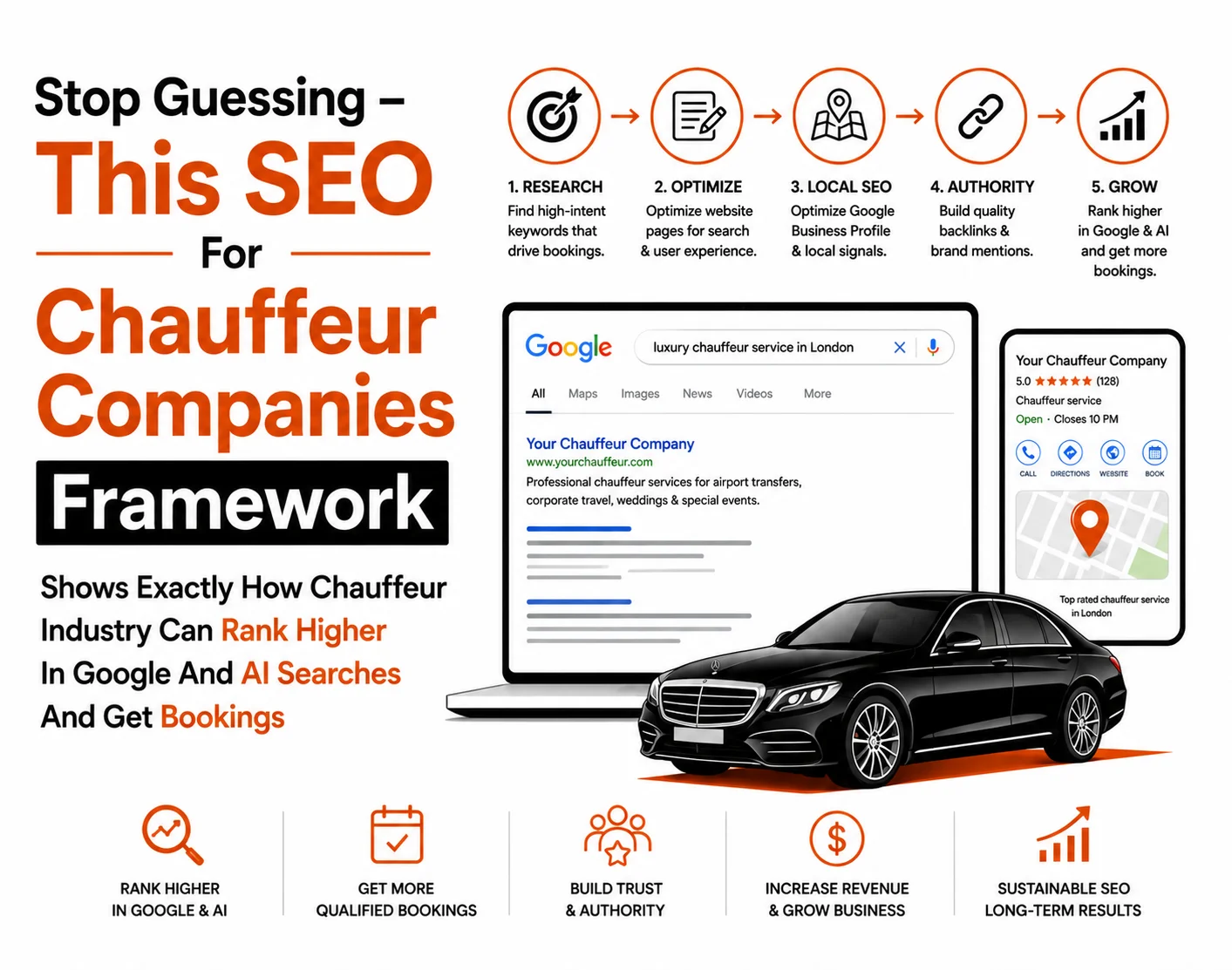
Stop Guessing - This SEO For Chauffeur Companies Framework Shows Exactly How Chauffeur Industry Can Rank Higher In Google And AI Searches And Get Bookings
Every chauffeur, black car, and limousine company wants inbound bookings from Google. Most never get them. This is the only complete SEO guide written by a specialist who works exclusively in the chauffeur industry — covering every strategy, every airport, every service type, and exactly what produced 300+ monthly bookings for a London chauffeur client from organic search alone.
Most chauffeur companies are not losing to better businesses. They are losing to better-structured websites. The company ranking above you for "executive chauffeur Heathrow T5" may have a smaller fleet and slower response time. But their website speaks the exact language Google needs to understand, trust, and rank them. This guide shows you exactly how to build that structure — from the ground up or on top of what you already have.
Section 01What Is SEO for Chauffeur Companies — and Why Is It Completely Different from Generic SEO?
SEO for chauffeur companies is the process of building a website architecture, content strategy, and local authority system that makes your business appear at the top of Google when a specific person searches for a specific service at a specific location. The critical word is specific.
Generic SEO agencies treat your chauffeur business like any other local service. They optimise your homepage, write a few blog posts, and build some backlinks. The result is a website that ranks vaguely for nothing and generates zero bookings. Chauffeur SEO is a completely different discipline because the search behaviour of your clients is exceptionally granular. Nobody just searches "chauffeur." They search "meet and greet chauffeur Heathrow Terminal 5," "executive car Canary Wharf to Mayfair fixed price," or "black car service JFK to Midtown Manhattan." Every one of those searches represents a person ready to book right now. And every one of them requires its own dedicated page to capture that booking.
Your clients are high-value, time-conscious, and trust-driven. A corporate PA booking an S-Class for her CEO does not browse ten websites. She searches for exactly what she needs, finds the first result that answers her specific question with specific information — including a fixed price, a named vehicle, and a clear booking process — and books immediately. Your SEO must be built to intercept that exact moment.
This guide covers every layer of chauffeur SEO — from the technical foundation that most companies have broken without knowing it, through the airport and service page architecture that generates real bookings, to the GEO and AEO strategies that position your brand in Google AI Overviews where none of your competitors have even thought to compete yet.
Section 02
Why Is Organic Search the Highest-ROI Marketing Channel for Chauffeur and Black Car Companies?
Paid advertising for chauffeur keywords is expensive, competitive, and stops generating bookings the moment you stop paying. A Google Ads campaign targeting "executive chauffeur London" can cost £8 to £22 per click in competitive markets — and those clicks convert at 3 to 5%. SEO produces the same traffic without the per-click cost, and it compounds over time rather than stopping when the budget runs out.
Our London chauffeur client invested £2,000 per month in SEO. By month 10, the organic search channel was generating 132 booking conversions per month with a 65% month-on-month growth rate. Their monthly revenue from organic search alone reached £30,000+. That is a 15x return on their monthly SEO investment — a figure that no paid advertising channel in the chauffeur industry can match consistently.
What does organic search traffic actually look like for a chauffeur company?
| Channel | Cost per booking | Scales without more spend? | Builds long-term asset? |
|---|---|---|---|
| Organic SEO | Drops over time as authority grows | Yes | Yes — compounds monthly |
| Google Ads (PPC) | £8–£22 per click, £60–£200+ per booking | Only with more budget | No — stops when budget stops |
| Social media ads | High — low purchase intent | Only with more budget | No |
| Booking platforms (Uber Black etc.) | 20–30% commission per booking | Platform-dependent | No — you own no audience |
| Referrals / word of mouth | Near zero | Difficult to scale | Partial |
Section 03
What NLP Entities and Semantic Keywords Must Every Chauffeur Website Cover?
Google's natural language processing system understands content through entities — specific named things (people, places, services, vehicles, regulations) that are associated with a topic. A chauffeur website that mentions only "chauffeur service" and "luxury vehicles" has thin entity coverage. A site that comprehensively covers all the named entities in the chauffeur industry signals deep topical expertise to Google's algorithms.
For AI systems like ChatGPT, Perplexity, and Google's AI Overviews, entity coverage is even more critical. These systems pull from sources that specifically name the entities relevant to a query. If your content names Heathrow Terminal 5 specifically, a Mercedes S-Class specifically, a TfL PCO licence specifically — you are far more likely to be cited in AI-generated answers than a competitor whose content only says "luxury airport transfers."
Which entities must a UK chauffeur company's website cover?
Which entities must a US black car or limo company's website cover?
Section 04
What Is the Correct Airport Page Architecture for a Chauffeur Company?
The airport page architecture is the single most impactful structural decision in chauffeur SEO. It is also the decision that almost every chauffeur company gets wrong. The default approach — one "Airport Transfers" page covering all airports — ranks for nothing because it cannot provide the terminal-specific depth that Google requires to rank it for any individual terminal search.
Every airport you serve needs at minimum one dedicated page. Every major terminal within that airport needs its own page. This is not duplication — it is specificity. A client at Heathrow Terminal 5 has different questions, a different meeting point, different waiting times, and different journey distances than a client at Heathrow Terminal 2. Google knows this. Your website must reflect it.
Which UK airport pages does every chauffeur company need?
| Airport / Terminal | Airlines Served | Search Volume Level | Priority |
|---|---|---|---|
| Heathrow Terminal 5 | British Airways, Iberia | Highest | Build First |
| Heathrow Terminal 2 | Star Alliance, United, Lufthansa | Very High | Build First |
| Heathrow Terminal 3 | American Airlines, Virgin, Emirates | High | Build First |
| Heathrow Terminal 4 | Malaysia, Cathay Pacific, SkyTeam | Medium-High | Build Second |
| Gatwick North Terminal | easyJet, TUI, Wizz | High | Build First |
| Gatwick South Terminal | British Airways, Emirates, Virgin | High | Build First |
| Stansted Airport | Ryanair, easyJet | Medium-High | Build Second |
| Luton Airport | Wizz, easyJet, Ryanair | Medium | Build Second |
| London City Airport | BA, KLM, Lufthansa | Medium | Build Second |
| Birmingham Airport | Multiple carriers | Medium | Build if you serve it |
| Manchester Airport | Multiple carriers | Medium | Build if you serve it |
What must every airport terminal page include to rank and convert?
- The specific meeting point within that terminal — arrivals hall, driver board location, car park meeting
- Real fixed prices for the 5 most common routes from that terminal, by vehicle class
- How flight tracking works and what the waiting policy is for delayed flights
- Step-by-step booking process specific to that terminal
- Vehicle options available with photos and specifications
- FAQPage schema with the 6 to 8 most common questions about that specific terminal
- Internal links to related route pages and to the fleet page for the vehicle types shown
Full breakdown of the airport page architecture — including terminal-level keyword clusters, content structure, and internal linking for every major UK and US airport.
Section 05
What Service Pages Does a Chauffeur Company Need to Rank for Every Booking Type?
Airport transfers generate the highest volume of chauffeur bookings, but they are not the only revenue stream. Corporate accounts, wedding bookings, events, hourly hire, and long-distance road trips each represent significant booking categories with their own distinct search behaviour. Each service type requires its own dedicated page — not a section on a combined services page, but a standalone page with its own URL, its own keyword cluster, and its own content written for that specific type of client.
Corporate Chauffeur & Executive Travel
Target: travel managers, PAs, executive assistants. Focus on duty of care, monthly invoicing, SLA guarantees, corporate account setup, GDPR compliance, and C-suite discretion. This audience searches differently — they need proof of reliability, not just a good price.
Wedding Chauffeur Service
Target: brides, grooms, wedding planners. Seasonal search volume peaks in spring and summer. These pages must include vehicle decoration options, timing flexibility, photography stops, and what happens if the ceremony runs late. Price is secondary to trust and reliability.
Events & Occasions Transfer
Ascot, Wimbledon, Glastonbury, theatre runs, corporate away days, birthday celebrations — each is a separate search cluster with its own peak booking window. Build event-specific pages that include venue proximity, parking context, and group vehicle options.
Hourly Hire & As-Directed
Corporate clients who need a vehicle and driver for multiple stops throughout a day. This page must explain the pricing model (per hour vs minimum hours), overtime policy, and the types of usage this service suits — meetings, client entertainment, roadshows.
Long-Distance & UK-Wide Transfers
High-margin bookings that most chauffeur companies ignore. London to Edinburgh, Birmingham to Manchester, London to Cotswolds — these route pages target a less competitive keyword cluster and generate very high-ticket bookings from clients who prefer door-to-door over flying.
Road Show & Multi-Stop Corporate
Investment banks, private equity, and C-suite executives on investor road shows need a dedicated vehicle and driver for multi-day, multi-city programmes. This is a premium, high-ticket service with very specific search intent that almost no chauffeur company has a dedicated page for.
School Run Chauffeur
A growing niche in premium London areas. Parents in Kensington, Chelsea, and Mayfair search for reliable daily school runs in luxury vehicles. This page targets hyper-local, repeat-booking clients with very high lifetime value.
VIP & Close Protection Transfer
High-net-worth individuals, celebrities, and executives requiring enhanced security. The content on this page must address confidentiality, vetted driver credentials, route planning, and vehicle specifications for security-conscious bookings.
Section 06
What Is the Correct Keyword Strategy for a Chauffeur or Black Car Company?
The most common keyword mistake in the chauffeur industry is targeting high-volume head terms like "chauffeur London" or "black car service New York" as the primary strategy. These terms are dominated by brands with 10 to 20 years of domain authority. The correct strategy targets intent-specific, location-specific, route-specific long-tail keywords first — then builds up to head terms as authority grows.
What are the four keyword intent types every chauffeur site must target?
- Transactional intent: "Chauffeur Heathrow T5 to Canary Wharf price" — book now, ready to pay
- Commercial intent: "Best chauffeur service London" — comparing providers before booking
- Informational intent: "How does meet and greet work at Heathrow?" — researching before deciding
- Local intent: "Executive car hire near Mayfair" — location-specific, often mobile search
Each intent type requires its own page type. Never put transactional and informational content on the same URL — Google cannot rank a page that tries to serve two different intents simultaneously. This is keyword cannibalization, and it is one of the primary reasons chauffeur sites stall between positions 11 and 30 for years without moving.
Full keyword strategy breakdown — including terminal-level clusters, route keyword lists for UK and US markets, cannibalization fixing, and the complete intent-to-page mapping system.
Section 07
What Technical SEO Issues Are Most Chauffeur Company Websites Getting Wrong?
Technical SEO is the foundation that every other strategy is built on. No amount of content, schema, or keyword targeting matters if Google cannot properly crawl and index your pages. In our analysis of chauffeur company websites across the UK and US, the same five technical failures appear repeatedly — and half of the companies experiencing them have no idea the problem exists.
50% of service pages are not in Google's index
Type site:yourdomain.com in Google. The number of results is how many pages Google knows about. Most chauffeur companies discover that their most important service pages — airport terminals, route pages — have never been indexed. A page Google cannot see cannot rank. Fix this before anything else.
Mobile speed failing Core Web Vitals — 70% of searches are on mobile
70% of chauffeur and black car searches happen on mobile phones. Google's Core Web Vitals rank mobile experience as a direct ranking factor. A Largest Contentful Paint above 2.5 seconds on mobile actively suppresses your rankings. Most chauffeur sites score below 50 on Google PageSpeed Insights mobile — a score that costs positions daily.
No schema markup — invisible to AI and rich results
Without LocalBusiness, Service, FAQPage, and Review schema, Google cannot categorise your pages correctly. You are excluded from rich results, the local map pack enhanced listings, and Google AI Overviews. Schema is the bridge between your written content and machine-readable signals. It is not optional in 2026.
Duplicate content across location and terminal pages
If your Heathrow T5 page and Heathrow T2 page share the same body text with only the terminal name changed, Google treats them as near-duplicate content and ranks neither. Every terminal and location page must have genuinely unique content — specific pricing, specific meeting point detail, specific vehicle recommendations, and specific journey information unique to that location.
Broken booking form on mobile
A client who has chosen you, found your page, and gone to book — then abandoned because the form does not work on their phone — is the most expensive conversion failure in your entire funnel. Test your booking form on every screen size. If it requires pinch-zooming, excessive scrolling, or loads slowly, you are losing confirmed bookings every day.
Section 08
How Do You Do Local SEO and Google Business Profile for a Chauffeur Company?
Local SEO for chauffeur companies has two distinct components: the organic local search results and the Google map pack. Both require different strategies and both generate different types of bookings. The map pack drives high-intent, location-specific bookings — particularly from mobile searches. Organic local results drive the broader range of service and route searches.
What does a fully optimised Google Business Profile for a chauffeur company look like?
- Primary category: Chauffeur Service — not just "Transportation" or "Car Service"
- Service area: every postcode cluster and district you actively serve, not just your registered address
- Every service listed individually with descriptions and price ranges where possible
- Minimum 25 high-quality photos — vehicle interiors, exteriors, uniformed drivers, meet and greet signage
- Google Posts published weekly — seasonal availability, event coverage, new routes
- Q&A section populated with the 10 most common client questions, answered by you before anyone else asks them
- A systematic review request process: message every client within 2 hours of booking completion with a direct review link
- Response to every review — positive and negative — within 24 hours
The honest truth about map pack competition: The chauffeur companies ranking in the London map pack have been building their Google Business Profile authority for 10 to 15 years. They have 80 to 300+ reviews accumulated over that time. You cannot beat them in 3 months. What you can do is build organic ranking through website SEO — which generates bookings regardless of map pack position — while building your GBP authority consistently over 12 to 18 months.
Section 09
How Do Chauffeur Companies Appear in Google AI Overviews and AI Recommendations?
This is the most significant competitive advantage available to any chauffeur company right now — and almost none of your competitors are pursuing it. Google AI Overviews, ChatGPT responses, and Perplexity answers increasingly appear above traditional organic results. A chauffeur company cited in a Google AI Overview for "best meet and greet chauffeur Heathrow T5" receives visibility that is literally above position one in the search results.
Our London chauffeur client is featured in Google AI Overviews for hundreds of terms across airport transfers, corporate chauffeur, and event transport — despite not ranking position one for many of those terms in traditional results. The AI visibility generates booking enquiries that never even click a traditional organic result.
What makes chauffeur content get cited in Google AI Overviews?
Question-based H2 headings with direct 40–60 word answers
AI systems extract answers from pages that use question-format headings followed immediately by a direct, concise answer. "How does meet and greet work at Heathrow T5?" followed by a 50-word specific answer is the exact structure Google AI Overviews pull from. Generic heading styles like "Our Service Process" produce nothing.
FAQPage schema on every service and airport page
FAQPage schema is the most direct signal to Google that your content answers specific questions. Every service page and airport page must have a schema-marked FAQ block with 6 to 10 real pre-booking questions. This feeds People Also Ask boxes in traditional results and AI Overview citations simultaneously.
Specific, verifiable information — real prices, named vehicles, named locations
AI systems prefer specific, verifiable content over vague marketing language. "From £85 in a Mercedes E-Class for a Heathrow T5 to Canary Wharf transfer" is more citable than "competitive prices for all airport transfers." Named entities, specific figures, and verifiable facts increase AI citation probability dramatically.
Author expertise signals and EEAT
Google's Experience, Expertise, Authoritativeness, and Trustworthiness (EEAT) signals determine which sources AI systems trust. For chauffeur SEO content, this means named authors with verifiable industry experience, cited statistics, and content that demonstrates real operational knowledge of how airport transfers, corporate chauffeur, and meet and greet services actually work.
Section 10
Real Results: How Rankvi Generated 300+ Monthly Bookings for a London Chauffeur Company
Everything in this guide is not theory. It is the exact system that produced documented, tracked results for a real chauffeur company operating in London — the most competitive chauffeur market in the United Kingdom.
The client came to us with a website that had generic pages titled "Services," "Our Cars," and "Corporate." Those three or four pages were trying to target fifty different search intents simultaneously. They were invisible on Google for every specific airport terminal search. They had no pricing visible. No schema. No terminal-specific content. And they were waiting for inbound bookings that never came.
This chauffeur company invested in a 10-month SEO engagement. We built the complete airport page architecture, rewrote every service page around specific search intent, implemented full schema markup, and created a content programme targeting Google AI Overviews. The results are tracked directly from the booking form — every conversion verified.
What was the exact strategy that produced these results?
The client wanted to rank only for "London corporate chauffeur." We told them no. We targeted everything: all UK airport transfers across every major terminal, all major UK events (Ascot, Wimbledon, corporate away days), and high-margin long-distance family rides. We shifted the entire brand positioning from "affordable" to "executive protection and absolute trust." These are the six strategic moves that drove the results.
Built "money pages" for every airport terminal and service type
Replaced the generic "Services" and "Our Cars" pages with high-intent, terminal-specific pages for every Heathrow terminal, Gatwick North and South, Stansted, and Luton. Each page targeted one specific search intent with specific pricing, meet and greet detail, and a direct booking form.
Wrote trust content that converts humans and gets cited by AI
Removed all marketing fluff from every page. Replaced vague descriptions with specific answers to every question a client asks before booking — pricing, driver credentials, flight tracking process, cancellation policy, and vehicle specifications. Content optimised for Google and AI systems simultaneously.
Fixed internal linking — the most ignored ranking factor
Built a logical link structure from hub to terminal to fleet to booking form. Airport Transfers Page → Heathrow T5 Page → Mercedes S-Class Fleet Page → Booking Form. Google finally understood the luxury niche positioning and the relationship between service pages, which lifted rankings across the entire domain.
Targeted Google AI Overviews — a gap no competitor had filled
No other chauffeur company in London was targeting AI Optimisation in 2024. Even the top-ranking sites had this gap completely open. We created a content structure that answers user questions so specifically and comprehensively that the site is now featured in Google AI Overviews and AI recommendations across hundreds of chauffeur and airport transfer terms.
Stopped chasing cheap keywords — targeted executive intent only
Removed all "affordable" and "cheap" positioning. Focused exclusively on executive intent keywords: "Private Chauffeur Service London," "Executive chauffeur hire Canary Wharf," "Executive Luton transfer service." These keywords bring booking-ready clients — not price-shoppers — and they became the base of a returning client relationship that now drives consistent monthly revenue.
Built real authority links — luxury travel, corporate, and event sources
Secured features on luxury travel and business lifestyle publications, links from UK event planning and wedding venue websites, and mentions in high-tier UK business directories. No cheap link farms. Every link placed in a context that a chauffeur client would genuinely read and trust — which is exactly what Google weights most heavily.
Section 11
How Long Does SEO Take for a Chauffeur or Black Car Company — Realistic Timelines by Market
This is the question every chauffeur company owner asks first — and the one that causes the most disappointment when answered honestly. The timeline for chauffeur SEO is determined by three factors: the competition level in your market, the authority your competitors have already built, and how completely you execute the architecture described in this guide.
Before taking on our London chauffeur client, we spoke with over 50 chauffeur companies across the UK. Many wanted to "dominate London in 3 to 4 months." Some compared our rates to £300 per month generalist agencies. The companies that went with cheap generic agencies are still on pages 8, 9, and 10 — years later, still paying, still invisible. The companies that have been on pages 3, 4, and 5 for years are not failing to invest. They are investing in people who do not understand what actually works for the chauffeur industry specifically. That is the difference.
| Market | Competition Level | Realistic Timeline to Consistent Bookings | Who You Are Competing Against |
|---|---|---|---|
| London Central | Extreme | 10–14 months | iChauffeur (20yr), Blacklane (12yr), established PCO operators |
| New York / LA | Extreme | 10–14 months | Dial 7, Carmel, established black car networks |
| Manchester / Birmingham | High | 6–9 months | Regional operators with 5–10 years of authority |
| Chicago / Dallas / Miami | High | 6–10 months | Established local limo and black car operators |
| Mid-size UK / US city | Moderate | 3–6 months | Fewer established operators — faster to build |
| Smaller local market | Lower | 60–90 days | Directory listings and thin sites — faster wins possible |
One critical truth from our London experience: you do not need to rank position one for all target keywords to generate consistent bookings. Our chauffeur client generates 300+ monthly conversions while not ranking position one across all target keywords. They appear in Google AI Overviews for hundreds of terms — which places them above position one — and their airport terminal pages convert at rates that make position three as profitable as position one for a competitor with a weaker, less specific page.
Frequently Asked Questions About SEO for Chauffeur Companies
Real questions from chauffeur and black car company owners about organic search, Google rankings, and booking growth through SEO.
Ready to Build a Real Booking Engine for Your Chauffeur Fleet?
We currently have limited slots available for London to ensure clients dominate that high-competition market. If you are targeting UK cities or the US market, we have open slots to help you build organic booking growth.
