


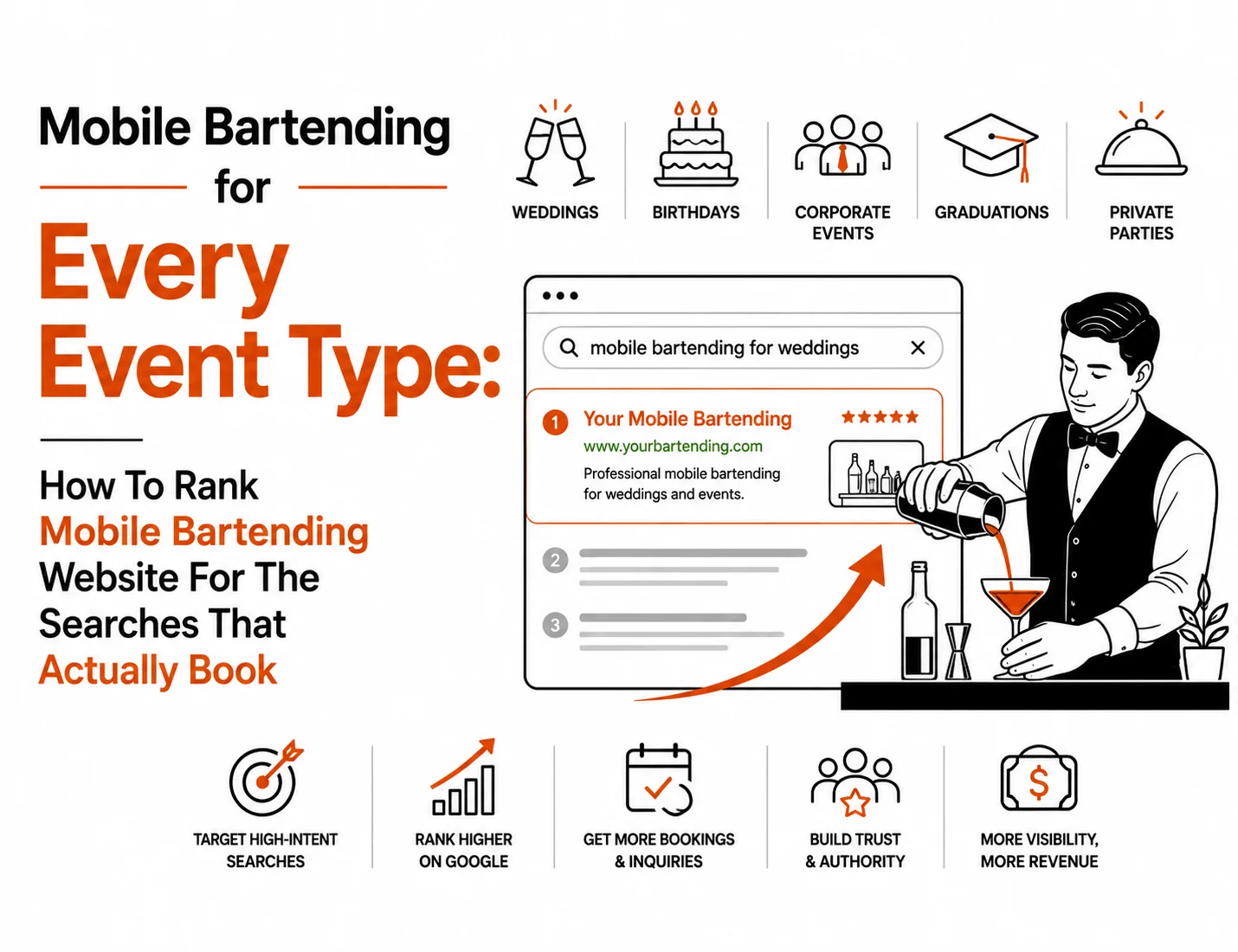
Optimize Mobile Bartending Website For Every Event Type: How To Visible Mobile Bartending Website For The Searches That Actually Book
A complete guide for mobile bartending businesses on structuring content, service pages, intent for different events and SEO strategy around the specific events your clients are searching for and why one generic page is costing you bookings every single week.
Here is a scenario that plays out every day in markets across the UK and US. A bride opens Google and types "mobile bar hire for outdoor wedding in London." Three results appear in the Map Pack, and five or six appear below in the organic SERO results. 85% chance she clicks the first one that looks relevant for that query she search in Google or ask AI for recomendations, reads for thirty seconds, and either submits an enquiry or goes back to try the next result.
Your mobile bartending business may be the best option in that market. But if your website has one generic services page that mentions weddings in a single paragraph alongside corporate events, private parties, festivals, and hen dos Google does not know that page is specifically about weddings. It cannot confidently rank it for a wedding-specific search intent. And so the bride never finds you.
This article for mobile bartending companies explains exactly how to build the content architecture that changes that. Not just for weddings, but for every event type your business serves so that the right client finds the right page at the right moment, and your website becomes the place that gets booked instead of the one that gets scrolled past.
Mobile bartending also referred to as bartending in its broader professional context is a service built around transporting a complete bar setup to an event location and providing drinks service on-site. Understanding how clients search for this service, and why each event type attracts a different buyer profile, is the foundation of effective SEO in this niche.
01
Why Event-Specific Pages Outrank Generic Services Pages — Every Time
Google's primary goal is to match a searcher's intent as precisely as possible. When someone types "mobile bartender for corporate event," Google is looking for a web page that is specifically, comprehensively, and confidently about corporate event bartending not a page that mentions it in passing among five other event types.
This is not a theory. It is the observable behaviour of Google's ranking algorithm, applied consistently across millions of local service searches. Pages that are tightly focused on a single topic a single event type, a single location, a single service outrank broader pages because they satisfy the searcher's intent more completely. Google calls this topical relevance, and it is one of the most actionable ranking factors available to a mobile bartending business.
The mathematics of a single services page
Suppose your current services page is 500 words and mentions six event types weddings, corporate events, private parties, festivals, hen parties, and charity events. That gives each event type approximately 100 words of coverage. A competitor who has built a dedicated 900-word wedding bartending page has given Google nine times more content to understand that page's relevance to a wedding search. Every search that includes the word "wedding" will, all other things being equal, favour the more specific page.
Multiply this across every event type you serve. A business with six dedicated event pages is competing in six separate search channels simultaneously. A business with one generic services page is competing in none of them effectively.
One event type. One page. One set of targeted keywords intent. One collection of client-specific questions and answers. This is the content architecture that earns organic rankings and organic bookings.
What Google Sees On A Well-Built Event-Type Page
When Google's crawler lands on a page titled "Mobile Bar Hire for Weddings in Los Angeles," it sees: the event type in the H1 heading, the location in the URL and opening paragraph, wedding-specific vocabulary throughout the body copy (bridal party, reception, wedding venue, signature cocktail menu, themed bar), and a FAQ section answering wedding-specific questions. Every signal points in the same direction. Google understands with confidence what this page is about and who it is for. That confidence translates into ranking.
02
How Different Clients Search And Why It Changes Everything About Your Content
The most important thing to understand about event-type SEO is that different clients use different language. Not slightly different — fundamentally different. A wedding couple and a corporate events manager are both looking for a mobile bartender, but they are searching for different things, asking different questions, and making decisions based on different criteria.
Wedding Clients: Emotion-led, Detail-Focused
A couple planning their wedding approaches a mobile bar decision with high emotional investment. They want to know whether you can match their theme, whether your bar setup will look beautiful in their venue's photographs, and whether your team understands the significance of the day. Their searches reflect this: "cocktail bar hire for wedding," "vintage mobile bar wedding," "prosecco bar hire outdoor wedding." They ask questions about personalisation, aesthetics, and flexibility. Your wedding page needs to speak this language and specifically avoid the corporate, transactional tone that works on a different audience entirely.
Corporate Clients: Professionalism-Led, Logistics-Focused
A corporate events manager looking for bartending services is making a decision that reflects on their company. Their searches are functional: "professional bartending service for corporate event in Dallas, Texas," "dry hire bar corporate function," "cocktail service product launch London." They want to know about professionalism, reliability, insurance, customisation to brand guidelines, and what happens if something goes wrong. The language on your corporate page should mirror this precise, professional, operationally confident.
Private party clients: value and fun-led
Someone booking a mobile bar for their fortieth birthday or a house party is motivated by the experience and the value. They search for things like "hire a bartender for birthday party," "mobile bar for private party near me," "cocktail bartender for house party." They want to know it will be fun, that the price is fair, and that the process is simple. Complexity kills conversion in this segment your private party page should be warm, accessible, and clear about what they get.
03
Every Event Type, Its Keywords, and What the Page Needs
Below is the complete event-type content map for a mobile bartending business. For each event type, we identify the primary keyword cluster, the search intent, and the specific content elements that make the page competitive.
Your highest-value event type and most competitive keyword cluster. The page must answer aesthetic and logistics questions — venue restrictions, personalisation, how many guests per bartender, what is included in a wedding bar package.
High-average-spend bookings from events managers and HR teams. Content must signal professionalism, punctuality, liability coverage, and brand-alignment capability. Decision is often made by committee — testimonials with company names convert well.
High volume, lower average spend. The page should be warm, accessible, and simple. Lead with the fun experience. Pricing transparency is especially important here — private party clients are more price-sensitive than wedding clients.
Niche but high-volume searches in spring and summer. Content must address outdoor-specific concerns: power supply, weather contingency, licensing, crowd management. Seasonal content strategy around these searches is highly effective.
Fun-led, experience-focused. The organiser (maid of honour, best man) is usually searching on behalf of a group. Emphasis on themes, cocktail making experiences, Instagram-worthy setups, and package simplicity. Strong seasonal spike in spring.
Lower average spend but excellent for reviews, referrals, and local PR. Good content here includes information about operating within charity event budgets, experience with outdoor/marquee settings, and references to licensed bar operations.
The full keyword matrix — what each event type looks like in search
| Event type | Primary keyword | Secondary keywords | Buyer profile |
|---|---|---|---|
| Wedding | mobile bar hire for wedding | cocktail bar wedding, prosecco bar wedding, vintage bar hire wedding | Couple, wedding planner |
| Corporate | corporate event bartender | mobile bar corporate event, dry hire bar office party, cocktail service product launch | Events manager, HR team, EA |
| Private party | hire bartender for private party | mobile bartender birthday party, home party bartender, cocktail bar house party | Individual host |
| Festival / outdoor | mobile bar hire festival | outdoor event bartender, mobile bar summer party, garden party cocktail bar | Event organiser, venue |
| Hen / stag | mobile bartender hen party | cocktail bar hen do, mixology experience hen night, themed bar hire hen party | Maid of honour, best man |
| Charity / community | mobile bar hire charity event | bartender community event, non-profit event bar, licensed bar charity fundraiser | Event coordinator, charity staff |
What every event-type page must include
Regardless of the event type, every dedicated page should contain the following elements to be competitive in organic search:
- An H1 heading that includes the event type and your primary city or service area
- An opening paragraph that speaks directly to the client type — their specific event, their concerns, their vision for the day or evening
- A service description tailored to that event type — not copy-pasted from another page
- Pricing guidance — at minimum a "starting from" figure with what is included
- A FAQ section answering five or six questions specific to that event type
- Two or three testimonials from clients who booked for that specific event type
- A clear call to action in three positions: near the top, end of main content, after the FAQ
- Internal links to your homepage, about page, and at least one related blog article
- FAQPage schema markup implemented for the FAQ section
Location-specific variations: scaling the strategy
Once your core event-type pages are live and ranking, the next layer is location-specific variants. Instead of one wedding page, you create a primary wedding page targeting your largest city, and supporting location pages for satellite areas: "Mobile Bar Hire for Weddings in Surrey," "Wedding Bartender Bristol," "Cocktail Bar for Weddings in the Cotswolds."
Each location page is genuinely differentiated — it references specific venues in that area that you have worked at, mentions local wedding suppliers you work alongside, and uses location-specific vocabulary. This is not content duplication — it is content targeting, and it is how regional mobile bartending businesses own multiple location searches without building a presence in each city.
04
Pricing Transparency as an SEO and Conversion Signal
The question of whether to show prices on a mobile bartending website comes up in almost every conversation with bar owners. The concern is understandable — events vary enormously in size, complexity, and logistics, and a price quoted without context can either lose you a client who could have afforded more, or attract enquiries from people who genuinely cannot afford your service.
But the SEO case for transparent pricing is clear, and the conversion case is equally strong.
How much does a mobile bartender cost? — the most searched question in the niche
Across every event type, the question "how much does a mobile bartender cost" — and its variants — are among the highest-volume searches in the mobile bartending niche. A potential client does not search for this question unless they are seriously considering booking. This is a high-intent, bottom-of-funnel query.
If your website answers this question — clearly, specifically, with context about what is included — your service pages and blog content become eligible to rank for it, and to appear in Google's AI Overviews and People Also Ask boxes. If your website says "contact us for a quote," Google has nothing to cite, and the client has to work to find out whether your service is within their budget.
Do mobile bartenders provide the alcohol or does the client?
This is the second most common pricing-adjacent question in search data. The answer has a significant bearing on the total cost of booking a mobile bar and is therefore always asked during the research phase. Addressing it directly on your service pages — with clear explanation of the difference between full-service (bar, staff, and alcohol supplied) and dry hire (bar and staff only, client supplies alcohol) — captures a highly intent-driven search and eliminates a common source of enquiry friction.
Show a starting price with a clear indication of what it includes. Explain the key variables that affect total cost (guest numbers, duration, service type, travel distance). Answer the "do you supply alcohol?" question directly. Add a FAQ entry on your pricing page or service pages for each of these. This approach converts more leads than a blank "contact us" wall — and ranks for more searches.
How far in advance should I book a mobile bartender?
Another high-search-volume question that belongs on every event-type page and in your FAQ content. The answer — typically three to six months for weddings, one to three months for corporate events and private parties — also creates a natural urgency signal that you can use in your content strategy: seasonal "booking now for summer" messaging, early booking incentives, and availability-based CTAs that convert well with clients who are still in the consideration phase.
05
Seasonal Booking Patterns and How to Use Them in Your Content Strategy
Mobile bartending is a highly seasonal business. Understanding when different event types peak in search volume — and publishing content around those peaks — is one of the most effective yet underused tactics in this niche.
| Event type | Peak search months | Content action |
|---|---|---|
| Weddings | Jan–March (planning season), May–Aug (event season) | Publish wedding content in Nov–Jan to rank before planning season peak |
| Corporate events | Sept–Nov (Q4 planning), Jan–Feb (Q1 events) | Publish corporate content in Aug–Sept to capture Q4 budget decisions |
| Private parties | May–Aug (outdoor events), Nov–Dec (Christmas parties) | Publish summer content in March–April; Christmas content in September |
| Festivals / outdoor | April–July | Publish festival content in Feb–March to index before the season |
| Hen / stag parties | March–June (spring hen season), Sept–Oct | Publish hen party content in Jan–Feb to capture spring planning |
How seasonal content creates urgency-based bookings
Seasonal content goes beyond calendar-matching. An article published in March titled "How to Book a Mobile Bar for Your Summer Wedding — And Why You Should Act Before April" targets a searcher who is in the active planning phase, creates genuine urgency (summer availability is real and finite), and positions your business as the informed expert that understands the realities of event planning.
This type of content — which is genuinely useful, seasonally relevant, and commercially targeted — is exactly what Google's AI Overviews are designed to surface. When someone searches "when should I book a mobile bar for my wedding," a well-structured article that answers that question directly, with specific timeframes and practical advice, is a prime candidate to be cited as the authoritative source.
Building an event-type content calendar
The practical application of seasonal content strategy is a twelve-month editorial calendar that maps each event-type blog article and service page update to its optimal publication window. This does not mean producing twelve different pieces of seasonal content every month — it means planning two or three seasonal pieces per quarter, timed to rank before each event season rather than during it.
SEO content takes time to index and rank — typically four to eight weeks for a new page on an established site. Publishing wedding content in January gives it until March to build authority before the peak planning period. Publishing it in May means you missed the window entirely.
06
Frequently Asked Questions
Mobile bartenders work at a wide range of events including weddings, corporate functions, private birthday parties, hen and stag parties, festivals and outdoor events, charity fundraisers, anniversary celebrations, and graduation parties. The best mobile bartending businesses build dedicated service pages for each event type they target, allowing them to rank in Google for the specific searches each client type uses.
Wedding mobile bar hire typically starts from £600 to £900 for smaller events and ranges up to £2,500 or more for larger weddings with full-service packages including staff, equipment, and a personalised cocktail menu. The total cost depends on guest numbers, event duration, whether the package includes alcohol or is dry hire, and travel distance. Most mobile bartending businesses charge per hour of service plus a setup fee, with wedding packages often priced as a flat rate for a defined guest count and time period.
Yes. Mobile bartending is well-suited to corporate events including product launches, company away days, client entertainment evenings, office Christmas parties, and conference networking receptions. Corporate clients typically prioritise professionalism, punctuality, and the ability to customise the bar setup to brand guidelines. A well-positioned mobile bartending business targeting corporate clients builds a dedicated corporate service page that addresses these priorities specifically — distinct from their wedding and private party content.
A standard mobile bartending package typically includes the bar setup and equipment, a qualified bartender or team of bartenders for the event duration, glassware, garnishes and accessories, a pre-agreed cocktail menu, and setup and breakdown time. Whether alcohol is included depends on whether the package is full-service (everything supplied) or dry hire (bar and staff only, client provides alcohol). Premium packages often include a bespoke cocktail menu design, branded elements, and a dedicated event manager.
This depends on the package type. Full-service packages include the alcohol — the bartender supplies everything needed for the agreed cocktail menu, including spirits, mixers, garnishes, and ice. Dry hire packages include the bar setup, equipment, and staff, but the client is responsible for purchasing and providing the alcohol. Full-service packages are more expensive but more convenient; dry hire packages offer more flexibility and can be more cost-effective for larger events where the client can purchase alcohol at trade prices.
For weddings, the recommendation is three to six months in advance — and up to twelve months for summer weekend dates, which book up earliest. For corporate events, one to three months is typically sufficient. For private parties, four to eight weeks is generally adequate, though peak periods (Christmas, Bank Holiday weekends, school holidays) should be booked further in advance. Popular mobile bartending businesses fill their peak dates quickly; booking early also allows time for bespoke menu development and personalisation.
Google ranks pages based on how precisely and comprehensively they satisfy a specific search query. A wedding couple searching "mobile bar hire for wedding" is looking for a page that is specifically about wedding bar hire — addressing their aesthetic concerns, their logistical questions, and their specific decision-making criteria. A generic services page that mentions weddings alongside five other event types cannot compete with a dedicated wedding page on that search. Separate pages for each event type allow a mobile bartending website to compete effectively across multiple search channels simultaneously, which is the foundation of sustainable organic booking growth.
Is Your Mobile Bar Invisible to the Clients Who Are Searching for It Right Now?
Rankvi specialises in SEO for mobile bartending businesses. We build the event-type page architecture, content strategy, and local authority that turns organic search into a consistent booking pipeline.
