

From 17 Monthly Visitors to $7M+ in Contracts Through Organic Search
A precision parts manufacturer serving automotive, aerospace, and medical industries had near-zero online visibility. No engineer could find them on Google. Over 24 months, we changed that completely — without a single paid ad.
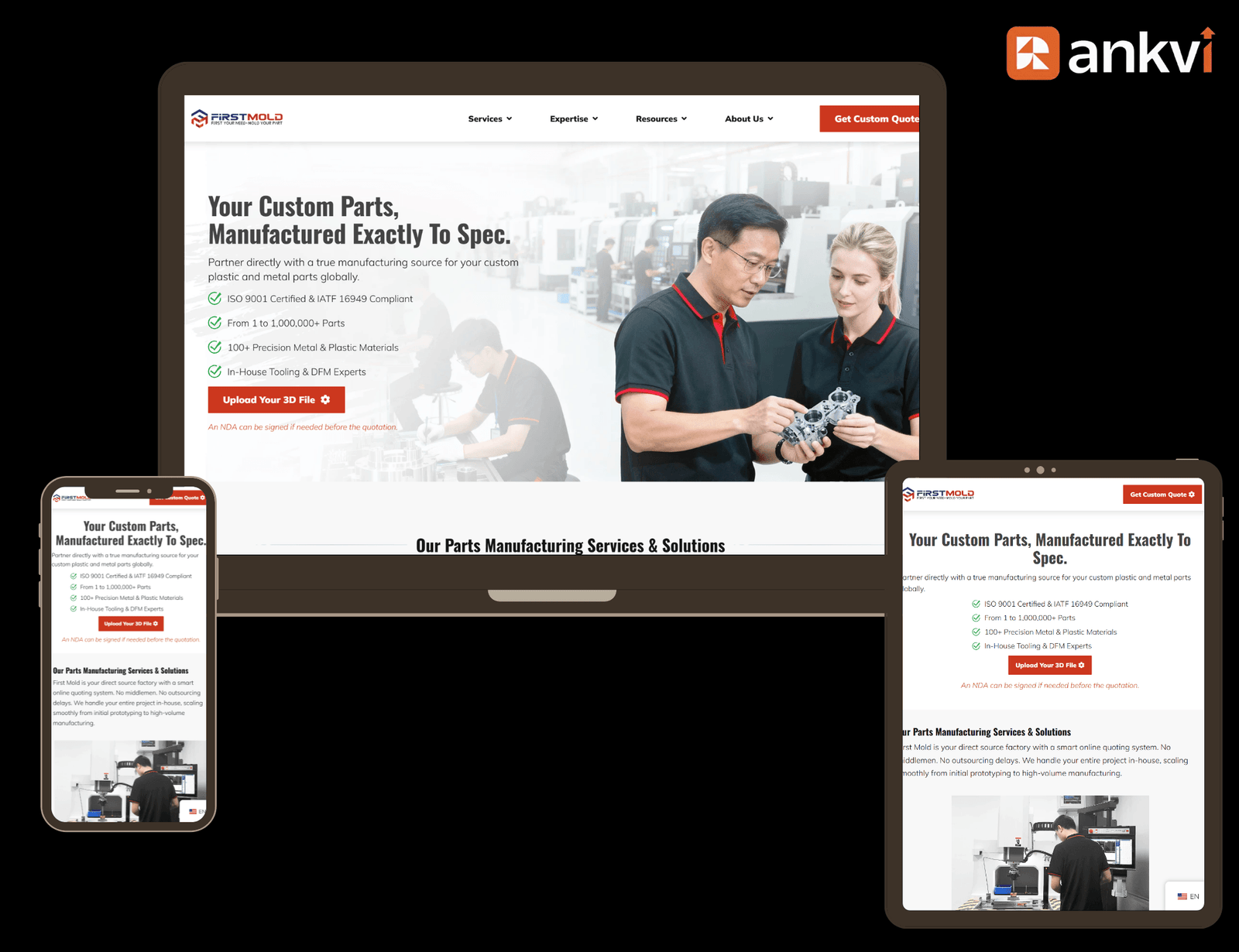
A World-Class Manufacturer That Nobody Could Find
When we first audited this precision manufacturing company, the gap between their production capabilities and their online visibility was staggering. They had an ISO 9001 certified facility, IATF 16949 compliance, the ability to machine to ±0.005mm tolerance, and a full range of injection molding, mold making, and CNC machining services for the automotive, aerospace, and medical industries.
And in November 2023, when an engineer in France searched for a precision injection mold maker, this company did not appear. Anywhere. Their organic traffic was 17 visitors per month. Their most valuable service pages — 5-axis CNC machining, precision mold making, injection molding for automotive — were either not indexed or completely invisible in search.
They were generating business entirely through trade shows and referrals. A reliable strategy — but one with a ceiling. Every engineer who searched Google for a precision parts supplier went somewhere else. The company was invisible to the largest, fastest-growing procurement channel in manufacturing.
That was the problem we were brought in to solve.
What We Found vs What We Built
The gap between what the website was and what it needed to be was significant — but every gap was fixable with the right strategy.
What We Found When We Audited
- Website built for brochure purposes, not built for engineers searching by specification
- No dedicated pages for individual processes — CNC milling, turning, 5-axis machining all lumped together
- Content talked about the company, not about materials, tolerances, certifications or applications
- Service pages not indexed by Google — invisible even when searching the exact company name + service
- Zero schema markup — Google could not understand what services existed or what industries were served
- Mobile speed failures — engineers searching from procurement systems on laptops hit slow load times
- No location or market-specific pages for France, US, UK, Germany — the highest-value export markets
- No content addressing the questions engineers ask before placing a contract (DFM, tolerances, certifications)
- No AI visibility — zero citations in ChatGPT, Perplexity, or Google AI Overviews
What We Built Over 24 Months
- Website architecture redesigned around how procurement engineers actually search — by process, material, tolerance, industry, and application
- Dedicated optimised pages for every individual process: CNC milling, CNC turning, 5-axis machining, precision mold making, injection molding, overmolding, rapid tooling, and more
- Content written in the language engineers use — specifications, tolerances, certifications, material datasheets, DFM guides, acceptance standards
- Every service page indexed, crawlable, and ranking — engineers can now find the exact capability they need
- Full schema markup deployed: LocalBusiness, Service, HowTo, FAQ — Google understands every capability and industry served
- Technical SEO foundation rebuilt: Core Web Vitals passing, mobile-optimised, zero crawl errors
- Market-specific content for US, UK, France, Germany, South Korea — top traffic markets all represented
- Deep topical content library: 1.8K pages now cited by AI tools including ChatGPT, Perplexity, and Google AI Overviews
- AI visibility score of 14 with 89 mentions and 1,800+ cited pages across all major AI search platforms
The Three Things That Changed Everything
We did not apply a generic SEO template. We built a system specifically for how procurement engineers and product managers find and evaluate precision manufacturing partners online.
We Redesigned The Website Architecture For Engineers, Not Executives
The original website was structured like a company brochure. It told visitors who they were. Engineers do not care about that first — they care about whether you can machine their part to tolerance, what materials you work with, whether you hold the certifications their supply chain requires, and whether you have done it for their industry before. We rebuilt the entire page structure around these questions. Every service got its own dedicated page. Every industry — automotive, aerospace, medical, consumer electronics — got its own content hub. Every material, every process, every certification was made findable. The result was a website that spoke in the same language as the engineers searching for it.
We Wrote Content That Speaks To Engineers And That Google Considers An Authority
Generic manufacturing content does not rank. It gets lost among thousands of identical pages. We wrote content that engineers actually find useful — detailed guides on injection mold acceptance standards, DFM analysis for precision parts, material selection guides for aerospace applications, tolerance comparison guides for 5-axis versus 3-axis machining. Content at this depth demonstrates genuine manufacturing expertise. Google rewards it with authority. AI tools cite it when engineers ask manufacturing questions. And most importantly — engineers who read it arrive at a consultation already trusting the company as an expert. This content now accounts for 1,800+ cited pages across ChatGPT, Perplexity, and Google AI Overviews — not because we specifically optimised for AI, but because deep, accurate, useful content is exactly what AI tools are built to surface.
We Built The Technical Foundation That Makes Everything Else Visible
Great content on a technically broken website is invisible. When we audited the site, we found multiple service pages not indexed by Google, Core Web Vitals failures on every primary landing page, zero schema markup, and mobile speed issues affecting the majority of traffic. We fixed everything: complete indexing audit and remediation, Core Web Vitals optimisation, full schema markup deployment across all service and category pages (including Service, LocalBusiness, HowTo, and FAQ schema), and mobile speed optimisation. Within 90 days of the technical fixes, previously invisible service pages began ranking. Within six months, the first high-value contract enquiries came in from engineers who found the site through Google Search — something that had never happened before.
The Organic Growth Curve
From 17 monthly visitors in November 2023 to 37,311 in June 2026. This is what consistent, compounding organic search investment looks like over 24 months.
We Did Not Optimise For AI. We Just Wrote Well.
One of the most significant outcomes of this project was not something we specifically planned for — it emerged naturally from the quality of the content we created. AI platforms like ChatGPT, Perplexity, Google AI Overviews, and Google AI Mode now regularly cite this manufacturer's content when engineers ask manufacturing questions.
1,800+ pages are now cited by AI platforms. 89 active AI mentions. An AI visibility score of 14 across ChatGPT, AI Overviews, AI Mode, and Gemini.
This happened because we wrote content that genuinely answers the questions engineers ask — at the depth and specificity that manufacturing expertise requires. AI tools are designed to surface the most accurate, most detailed, most useful answer available. When your content is that answer, you get cited. Not through tricks. Through expertise.
This is the lesson that applies to every industrial and B2B manufacturer: the same content quality that earns Google rankings also earns AI citations. They are not separate strategies. They are the same investment compounding across two channels simultaneously.
Total AI Visibility Score: 14. 89 active AI mentions. 1,800+ cited pages. Appearing in AI-generated answers for precision manufacturing, injection molding, CNC machining, and industrial procurement questions — without a single hour spent specifically on AI optimisation.
The Numbers That Matter
Not traffic for the sake of traffic. Engineers finding a manufacturer, evaluating their capabilities, and placing contracts.
How We Built Content Engineers Actually Search For
Engineers search differently from consumers. They search by specification, by material, by process, by certification. We mapped every search intent and built content that matched each one.
Specification-Level Keyword Research
We mapped every search an engineer makes when sourcing precision parts — “5-axis CNC machining aluminium aerospace,” “injection mold maker IATF 16949,” “precision mold making ±0.01mm.” These terms are never searched by consumers. They are only searched by qualified buyers ready to issue an RFQ.
Process & Capability Pages Built For Search
Every manufacturing process — CNC milling, CNC turning, 5-axis machining, plastic injection molding, insert molding, overmolding, rapid tooling, production tooling — got its own dedicated, specification-rich page. Engineers searching for specific capabilities find exactly what they need.
Industry Application Pages
Automotive, aerospace, medical, consumer electronics, and industrial equipment — each industry has different compliance requirements, different tolerance standards, and different procurement criteria. We built application pages that speak directly to each sector’s specific needs and certification requirements.
Deep Technical Resource Library
DFM guides, mold acceptance standards, CNC machined part acceptance standards, material selection guides, tolerance comparison guides. Content at this depth does not just rank — it builds trust. Engineers who find this content arrive at a quote request already qualified and already confident in the manufacturer’s expertise.
Market-Specific Localisation
The five largest traffic markets — US (5,700/mo), Mexico (4,100/mo), South Korea (3,600/mo), plus UK and Germany — each have different procurement terminology and compliance expectations. Market-specific content captured these segments and made the company visible to procurement teams across multiple continents.
Schema Markup For Every Page Type
Full structured data implementation: Service schema for every capability, HowTo schema for process guides, FAQ schema for technical questions, LocalBusiness schema for entity recognition. Schema markup is what allowed Google and AI tools to understand not just the words on each page, but the meaning behind them — accelerating rankings across hundreds of terms simultaneously.
Three Disciplines That Made This Possible
We rebuilt the entire site structure around how procurement engineers search — by process, material, tolerance, industry, and application. Every capability got its own dedicated page. Every industry got its own content hub. The result: a website that Google understands completely and engineers find exactly what they need.
Every piece of content was written with deep manufacturing industry knowledge — the exact specifications, tolerances, certifications, and material properties that engineers evaluate when sourcing precision parts. This semantic depth is what earns topical authority, what drives AI citations, and what converts engineers from visitors to RFQ submissions.
We did not apply a generic SEO playbook. We built a strategy specifically for how the precision manufacturing industry operates online — B2B procurement search patterns, specification-level keyword intent, certification-driven trust signals, and the technical depth that earns authority with both search engines and procurement teams simultaneously.
Sample of High-Intent Keywords Now Ranking
These are not traffic keywords. These are procurement keywords — searched by engineers and sourcing managers when they are ready to issue a request for quotation.
| Keyword | Type | Intent | Position |
|---|---|---|---|
| injection molding service | Service | Procurement | Top 3 |
| precision CNC machining | Service | Procurement | Top 10 |
| 5-axis CNC machining service | Service | Procurement | Top 10 |
| plastic injection mold maker | Service | Procurement | Top 10 |
| rapid prototyping service | Solution | Procurement | Top 10 |
| low volume injection molding | Solution | Procurement | Top 10 |
| DFM analysis injection molding | Technical | Research / Pre-RFQ | Top 3 |
| insert molding service | Service | Procurement | Top 10 |
| automotive injection molding | Industry | Procurement | Top 10 |
| CNC machining materials | Technical | Pre-RFQ Research | Top 10 |
26,200+ total keywords ranking. 651 in Top 3 positions. 2,646 in positions 4–10. Data: Semrush, June 2026.
How 24 Months of Compounding Work Looked
SEO is not a switch. It is a compounding investment. Here is how we built, month by month, from invisible to dominant.
Full Audit, Architecture Rebuild, Technical Fixes
Complete technical SEO audit. Indexing failures identified and resolved. Core Web Vitals fixed across all primary pages. Website information architecture redesigned from scratch — new page hierarchy based on procurement search intent. Service page structure mapped for every capability. Schema markup deployed across all existing pages.
17 organic visitors/month at startService Pages Live, First Rankings Appear, First $1M in Contracts
Dedicated service pages for CNC milling, CNC turning, 5-axis machining, precision mold making, injection molding, overmolding, and insert molding all published and indexing. First organic rankings appear for specification-level procurement terms. Within four months of beginning work, the first $1M in contracts attributable to organic search enquiries was recorded.
First $1M in organic-sourced contractsIndustry Pages, Deep Technical Content, AI Citations Begin
Industry application pages published for automotive, aerospace, medical, and consumer electronics. Deep technical resource library begins: DFM guides, material selection guides, tolerance comparison guides, acceptance standards for CNC machined parts and injection molded parts. Traffic crosses 8,000 monthly visitors. AI platforms begin citing content — the technical depth earns citations in Google AI Overviews and AI Mode without any specific AI optimisation effort.
8,000+ monthly visitors — AI citations beginMarket Localisation, 15+ Monthly Enquiries, Mid-Programme Milestone
Market-specific content deployed for US, Mexico, South Korea, UK, and Germany. Organic traffic crossing 18,000 monthly visitors. Contact form enquiries consistently at 15+ per month — all qualified contract opportunities from engineers who found the website through Google. Authority Score reaches 36. Referring domains grow to 2,300+.
18,000 visitors/month — 15+ enquiries/month37,311 Monthly Visitors, $7M+ in Contracts, 1.8K AI-Cited Pages
Final programme milestone. 37,311 monthly organic visitors. 26,200+ keywords ranking. 651 keywords in Top 3 positions. 1,800+ pages cited by AI platforms including ChatGPT, Google AI Overviews, AI Mode, and Gemini. $7M+ in total contract revenue attributed to organic search enquiries over the 24-month period. The manufacturer now generates more inbound leads from Google than from any other channel.
$7M+ total — organic is now the #1 lead channelIn the first four months we were already seeing qualified contract enquiries from engineers we had never met, in markets we had never reached through trade shows. By month twelve, organic search had become our most valuable business development channel. The content they wrote answers the exact questions our buyers ask — it converted engineers into clients before they even contacted us.
Your next contract is searching Google right now. Are they finding you?
We work exclusively with precision manufacturers, machine shops, and B2B industrial companies. Book a free audit and we will show you exactly where your visibility gaps are.
Your Ideal Contracts Are Being Awarded
To Companies That Show Up First.
Every engineer searching for a precision manufacturer, CNC machine shop, or injection mold maker is a potential contract. The manufacturers who appear first get the enquiry. Everyone else gets nothing. Let us show you how to be first.
